

Prioritize erosion control first, then add sediment capture on top of it. If council conditions or state thresholds apply, prepare an Erosion and Sediment Control Plan before any clearing starts. Install perimeter controls and a stabilized entrance on day one, and set a weekly inspection schedule that continues until the site reaches permanent stabilization.
TL;DR:
- Effective erosion control through site staging and stabilization costs less overall than relying solely on sediment barriers to prevent soil loss.
- Inspections before, during, and after storms are crucial, with timely repairs to barriers and documentation to avoid enforcement actions.
- Proper basin design with a 2:1 length-to-width ratio and regular sediment removal significantly enhances sediment capture efficiency.
- Implementing a stabilized construction entrance is key to preventing mud tracking and ensuring site compliance.
- Most failures occur from poor maintenance and neglect rather than design flaws, making ongoing inspection and record-keeping essential.
Table of Contents
- Why Construction Sediment Control Matters On Every Site
- Preventing Erosion Before It Starts: Staging And Stabilization
- Sediment Barriers, Inlet Protection, And Basin Design
- Erosion and Sediment Control Plans: Who Needs One And What It Covers
- Your On-Site Checklist From Clearing To Final Stabilization
- Keeping Controls Working: Inspection And Maintenance Triggers
- How Rokworx Approaches Sediment Control On Real Sites
- Where To Check The Rules For Your Site
- The Gap Between Compliant On Paper And Compliant In Practice
- Sources
Why Construction Sediment Control Matters On Every Site
Sediment washing off a cleared site does real damage: it clogs stormwater drains, smothers waterway habitat, and turns a routine council inspection into an enforcement problem. Erosion control and sediment control solve different halves of the same issue. Erosion control keeps soil where it sits, through mulch, vegetation, and stable ground cover. Sediment control catches the soil that gets away anyway, through barriers, traps, and basins.
Skipping the first step to rely only on the second is the most common and costliest mistake on Australian building sites. A few reasons sediment control earns a line item in every project budget, not an afterthought:
- Sediment-laden runoff is a leading contributor to degraded waterway health near urban construction zones
- Clogged drains and blocked easements create liability that outlasts the build itself
- Fixing a washed-out batter or a fined site costs far more than the barriers that would have prevented it
Preventing Erosion Before It Starts: Staging And Stabilization
The cheapest sediment control measure is the one you never need because the soil never moved. Minimizing site disturbance through staging and phasing is consistently the most cost-effective strategy available to a builder, and it costs nothing but planning discipline.
A practical sequence looks like this:
- Limit the disturbed footprint. Clear only what the current phase needs, not the whole lot at once.
- Phase the earthworks. Open one section, stabilize it, then move to the next rather than exposing the entire site simultaneously.
- Stabilize temporarily and fast. Mulch, seed, erosion control blankets, or geotextile fabric all buy time on slopes and stockpiles.
- Divert clean water around the works and preserve vegetated buffers wherever the design allows.
Rokworx applies this same staging logic on erosion control projects across Melbourne: small, sequenced work zones almost always outperform a fully exposed site, even on tight schedules.
Pro Tip: Map your site’s natural flow paths before you clear a single tree. Controls placed after the fact almost always end up fighting water that’s already found its own route downhill.
Sediment Barriers, Inlet Protection, And Basin Design
Once soil is moving, you need devices that stop it before it reaches a drain, creek, or neighboring property. The main categories, and where each one earns its keep:
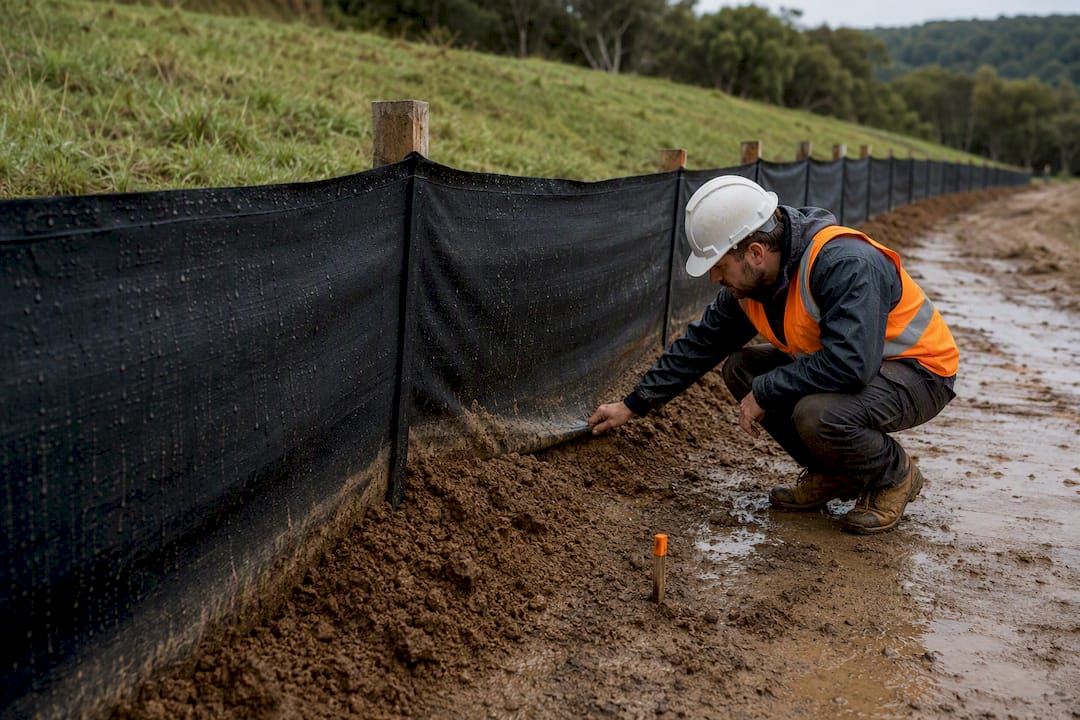
- Perimeter controls — silt fence, wattles or biologs, and rock berms installed on contour, with the ends curved slightly uphill so runoff can’t simply flow around the tips
- Inlet protection — filter socks, block-and-gravel setups, or prefabricated drain filters, all of which need checking for ponding since an overloaded inlet filter backs water up fast
- Channel and outlet protection — check dams, riprap, and level spreaders that slow water velocity before it concentrates into an erosive flow
- Sediment traps and basins — larger drainage areas typically require a basin rather than a simple trap, and sizing follows regional guidance tied to catchment area and expected runoff volume
Basin design has a rule of thumb worth knowing: a length-to-width ratio near 2:1, with baffles added to extend residence time so sediment actually has a chance to settle rather than just passing through. Remove accumulated sediment regularly before it substantially reduces basin effectiveness, not after it’s full.
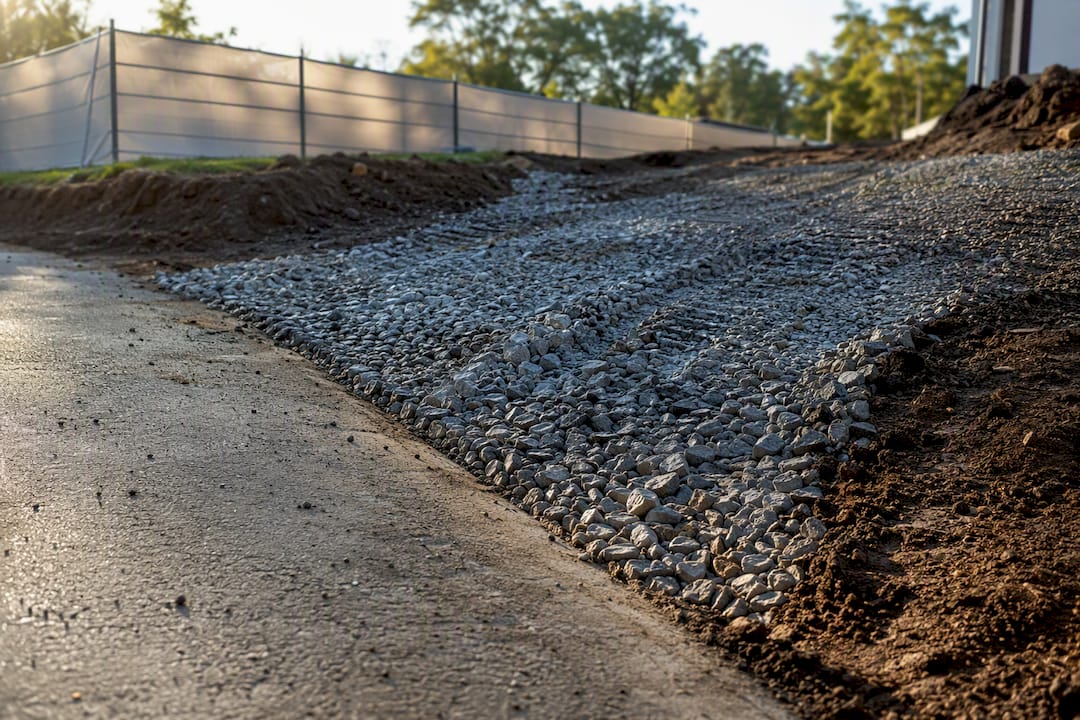
A stabilized construction entrance, usually a pad of coarse aggregate at the site access point, does more for compliance than most builders expect. It’s the single easiest way to stop mud tracking onto public roads, which is one of the most visible (and most reported) sediment failures on any job.
Erosion and Sediment Control Plans: Who Needs One And What It Covers
Most sites trigger an ESCP requirement through a development consent condition, a council threshold, or state planning guidance rather than a single blanket rule. NSW guidance notes that standard development conditions often require an ESCP prepared by a suitably qualified person, which means this isn’t a document you draft on a lunch break with a template pulled off the internet.
A functional ESCP generally includes:
- A site map showing existing drainage, slope, and disturbed areas
- The specific control measures selected and where each one sits
- A construction schedule tied to staging and stabilization timing
- Maintenance responsibilities and a decommissioning plan once permanent cover is established
Inspections back the plan up. Regulators expect inspections before work starts, weekly during active works, and immediately after storm events, with photographic records kept alongside written logs. That documentation matters as much as the physical controls themselves. Auditors have flagged sites with intact silt fences and functioning basins, but no proof anyone ever checked them, and treated that gap as seriously as a torn fence. EPA Victoria’s guidance is blunt about the consequence: failure to plan for predictable rain events and maintain records can lead directly to enforcement action.
Your On-Site Checklist From Clearing To Final Stabilization
- Finalize the ESCP and physically mark buffers and no-go zones before any clearing begins.
- Install perimeter controls and the stabilized site entrance before heavy machinery starts moving earth.
- Phase the works and stabilize exposed ground, aiming to cover bare soil within about 14 days using temporary seed or mulch.
- Assign a named person to run inspections, and set stockpile cover rules so exposed material isn’t left open overnight before rain.
- Decommission temporary measures only once permanent vegetation or hard surfacing is established.
This mirrors the small-site advice in YourHome’s sediment control guidance: cover stockpiles, minimize disturbance, and stabilize fast. Builders working near retained vegetation should also check transplant and root-zone protection practices before machinery gets close to mature trees, since root damage often shows up as slope instability months later.
Keeping Controls Working: Inspection And Maintenance Triggers
Controls degrade fast under Australian storm intensity, and a barrier that worked in week one can fail silently by week four if nobody checks it.
- Inspect before works start, every week during active construction, and immediately after any storm event
- Empty sediment traps or basins once they’re roughly half full rather than waiting for them to overflow
- Replace torn silt fence fabric and saturated wattles immediately, not at the next scheduled visit
- Log every inspection with a date, a photo, and a note on any repair or removal action taken
- Protect dewatering pump outlets with a filter bag or rock pad so pumped water doesn’t just create a new erosion point downstream
Pro Tip: Keep a spare roll of silt fence fabric and a few sandbags in the site shed. The fastest way to fail a post-storm inspection is scrambling to source repair materials while water is still running.
How Rokworx Approaches Sediment Control On Real Sites
Field conditions rarely match the textbook diagram. Rock berms and check structures need machinery placement, correct base preparation, and materials sized to the actual flow they’ll face, not a generic spec sheet. Rokworx builds these using coastal-grade rock mixes and sequences the earthmoving work so temporary basins go in before the site is fully exposed, not after runoff has already started moving.
Every site is different, and an ESCP written for one slope, soil type, and catchment won’t automatically fit the next. For anything beyond a straightforward residential build, get a qualified installer to walk the site and verify your plan against actual ground conditions before you break soil. If your project also calls for a rock wall or retaining structure that doubles as an erosion barrier, that’s worth designing in from the start rather than retrofitting later.
Where To Check The Rules For Your Site
Start with your state planning authority and EPA pages for technical specs and sizing tables. BMP handbooks and factsheets fill in inspection frequency and installation detail. Your local council has the final say on site-specific triggers, so confirm requirements there before finalizing any plan.
The Gap Between Compliant On Paper And Compliant In Practice
Most sediment control failures aren’t design failures. They’re maintenance failures dressed up as bad luck. A silt fence installed correctly in March and never checked again in June isn’t a control measure anymore. It’s a fence.
The industry’s compliance language, ESCPs, inspection logs, documented triggers, exists because regulators learned the hard way that installation alone doesn’t protect waterways. What protects waterways is someone walking the site after a storm and actually looking at whether the barrier held. That’s a cultural habit, not a paperwork exercise, and builders who treat it that way spend less time explaining themselves to council and more time building.
The other underrated point: prevention-first thinking saves money that sediment capture never can. A barrier that catches soil is still soil you paid to excavate, stabilize, and then remove from a trap. Staging your clearing so less soil ever moves in the first place is the cheapest control on this entire list, and it’s the one most schedules skip under time pressure.
— MYBMC
Sources
- Guidelines for erosion and sediment control on building sites (Planning Portal NSW)
- Construction sediment management – NSW Marine Estate
- Sediment control — YourHome
- Controlling construction site sediment run off — EPA Victoria


11 Comments
noblejiliapp
The app version is just fantastic. I can play on the go without any glitches. If you prefer mobile gaming, noblejiliapp is a must have.
Ardis
Thiis iis veery interesting, You’re a very skiolled
blogger. I hhave joied your rsss feed and loook forward too seeking more oof yor excelolent post.
Also, I hage shared your ste iin mmy soccial networks!
xnxx
db333
The emphasis on proactive site staging over reactive sediment barriers is crucial. This principle of preventative maintenance-whether controlling soil runoff or managing digital risk-is key to long-term success. Robust planning, like the system architecture needed for a reliable platform such as db333 অনলাইন ক্যাসিনো, minimizes costly failures.
phjljl16
Had some amazing luck today! The site is very responsive and easy to navigate even for beginners. Cheers to phjljl16 for the big win.
shihtzulieblinge
Reinrassige Shih-Tzu-Welpen europaweit adoptieren🐶
schaeferhundblutlinien
Reinrassige Deutsche Schäferhundwelpen europaweit verfügbar 🐕🦺
ragsiamglanz
Ragdoll-, Siam- & Ragamese-Kätzchen europaweit🐱
papageienparadies
Europas Premium-Papageien aus Hausaufzucht 🦜
imperiumvans
Own the Road. Command the Water
ph8jili
The Jili slots on this site are hitting different today. The graphics are crisp and the wins are coming in. Visit ph8jili for the best slot action.
bdr777betapk
Installing the app made everything so much easier. No more refreshing the browser, just instant access to the games. Love using bdr777betapk on my phone.