

Most native vegetation removal in Melbourne requires a planning permit, and local council is usually the authority that decides. Before touching a tree or clearing a block, check the Victorian Planning Maps for overlays and request written pre-application advice from City of Melbourne. If there’s any doubt, stop and get that confirmation in writing first. Unauthorized clearing carries fines that scale fast and can come with orders to revegetate the site.
TL;DR:
- Most native vegetation removal in Melbourne requires a permit from the local council, especially if overlays like Vegetation Protection or Significant Landscape are present.
- The application process varies depending on how much vegetation is being removed, with three pathways: basic, intermediate, and detailed, each requiring different assessments and reports.
- Oversights like hidden overlays or tight site access frequently cause delays or fines, so owners should confirm controls with written advice from the council before starting.
- Unauthorized clearing can lead to fines up to $300,000 and orders to restore the site, making early permit confirmation crucial to avoid costly penalties.
- Engaging experienced contractors and ecologists early helps streamline approvals and ensure compliance, especially in complex or overlay-affected sites.
Table of Contents
- What Regulations Control Land Clearing Permits in Melbourne?
- Who Issues the Permit: Council or State Government?
- What Are the Basic, Intermediate, and Detailed Pathways?
- Which Exemptions and Overlays Change Your Permit Requirements?
- How Do You Check What Controls Apply to Your Property?
- What Does the Application Process Actually Require?
- What Happens If You Clear Vegetation Without a Permit?
- What’s the Compliance Checklist Before You Break Ground?
- What I’ve Seen Trip Up Melbourne Property Owners
- How Rokworx Handles Permit-Ready Site Work in Melbourne
- Where to Verify Permit Requirements Officially
- Sources
- FAQ
What Regulations Control Land Clearing Permits in Melbourne?
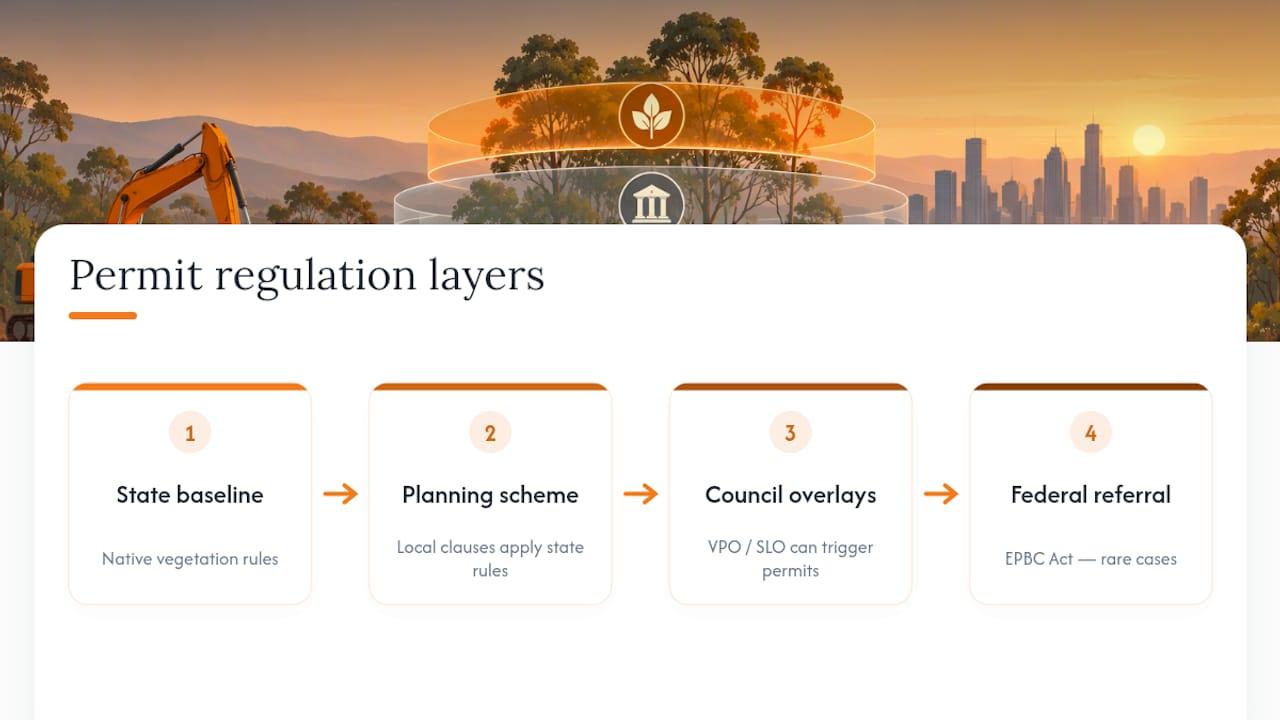
Victoria’s native vegetation removal regulations set the statewide baseline for what counts as native vegetation and when removing, destroying, or lopping it needs sign off. Those state rules get put into action locally through the planning scheme, specifically the clauses that cover native vegetation and bushfire protection. That’s the mechanism Melbourne councils actually use when they assess your application.
On top of the state baseline, individual council overlays can add their own permit triggers. A Vegetation Protection Overlay or Significant Landscape Overlay on your title can require a permit even for a tree the state rules wouldn’t flag on its own. In rare cases involving threatened species or Crown land, a project can also need referral under the federal Environment Protection and Biodiversity Conservation Act, which runs separately from Victoria’s own approval process. That’s uncommon for a typical residential or small development block, but it’s worth ruling out early if your site borders a reserve or waterway.
Who Issues the Permit: Council or State Government?
For most Melbourne properties, the local council is the responsible authority and the one that decides your application. The state, through the Department of Energy, Environment and Climate Action, gets involved when a project falls into the Detailed assessment pathway or involves large-scale clearing, at which point the council refers the application for a formal state assessment.
That referral step adds real time to your project, since the council’s decision now depends on sign off from another agency. The cheapest way to avoid a surprise referral is to ask first. City of Melbourne’s property enquiry service lets owners request written advice on whether a permit applies to their specific vegetation and location, and that advice is worth having on file before you commission any reports.
What Are the Basic, Intermediate, and Detailed Pathways?
Every native vegetation application in Victoria runs through one of three assessment pathways, and which one applies depends on how much vegetation you’re removing, whether large trees are involved, and where the site sits.
- Basic pathway: small removals with low landscape risk, typically requiring a straightforward application and site plan.
- Intermediate pathway: moderate-sized clearing or the presence of some larger trees, usually needing extra reports on habitat or tree condition.
- Detailed pathway: large-scale clearing, threatened species habitat, or multiple large trees, which almost always brings in ecological assessments, offset requirements, and possible state referral.
Knowing which pathway you’re likely to land in before you apply saves both time and consulting fees, since it tells you exactly what evidence the council will expect.
Which Exemptions and Overlays Change Your Permit Requirements?
A handful of narrow exemptions exist under the state framework, but they’re tighter than most owners assume.
- Routine maintenance of existing gardens or lawns
- Lawful existing use of the land that predates the vegetation controls
- Road safety works and authorized utility maintenance
- Crown land management and approved conservation work
Overlays complicate this picture. A Vegetation Protection Overlay, Significant Landscape Overlay, Environmental Significance Overlay, or Bushfire Management Overlay on your property can override a state-level exemption and require a local permit anyway. Owners frequently assume clearing is purely a council matter and get caught out when a title-based overlay triggers a state-level assessment they didn’t know existed.
Pro Tip: Never rely on a verbal “that’s fine” from a neighbor or a previous contractor. Photograph the site with a timestamp and get any exemption claim confirmed by council in writing before you clear a single branch.
How Do You Check What Controls Apply to Your Property?
Confirming your property’s controls takes three steps, and all of them are things you can do before spending a dollar on consultants.
- Search your address on the Victorian Planning Maps and download the Planning Property Report. Look specifically for zone details, any overlay schedules, and native vegetation precinct plan entries.
- Use City of Melbourne’s property enquiry tool to request written pre-application advice on your exact vegetation and site.
- Pull a recent Certificate of Title and check for any existing permit conditions or restrictive covenants tied to the land.
Schedule entries buried in the planning scheme can require a permit even for a small residential block, so this step matters regardless of how minor the clearing looks.
What Does the Application Process Actually Require?
A standard application needs a completed application form, a current Certificate of Title, site plans showing what’s being retained versus removed, and a written statement on how you’ve avoided or minimized clearing. Where the Detailed pathway applies, expect to add an offset statement and a formal ecologist or arborist report.
- Application form (standard planning permit or VicSmart, where eligible)
- Certificate of Title (recent copy)
- Site plans marking retained and removed vegetation
- Avoid/minimize statement
- Offset statement and ecological or arborist reports for Intermediate or Detailed pathways
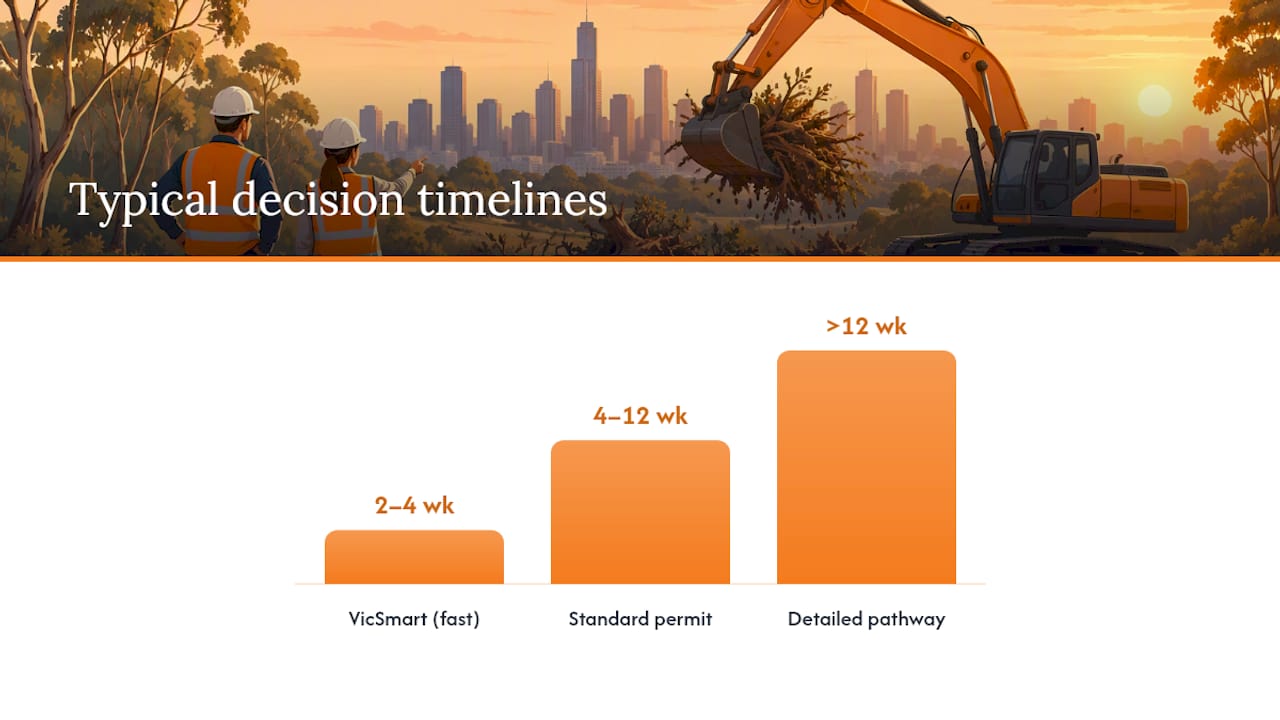
Some tree-related works qualify for VicSmart, a streamlined council process with a 10 working day decision window instead of the standard timeline.
Simple VicSmart matters typically resolve in 2 to 4 weeks. A standard council permit usually runs 4 to 12 weeks, and Detailed pathway applications with ecological referrals routinely take longer than 12 weeks. Offset costs vary just as widely: budgets can start in the low thousands for modest residential removals and climb into the tens of thousands where the vegetation has high habitat value. Engaging an ecologist early to scope the right pathway often cuts both the timeline and the eventual offset bill.
What Happens If You Clear Vegetation Without a Permit?
Unauthorized removal in Victoria carries real financial risk. Penalties range from around $1,000 for on-the-spot infringements up to $300,000 in serious court matters, and beyond the fine itself, the responsible authority can order you to revegetate or restore the cleared area at your own cost.
Courts weigh the scale of the breach and whether it was a corporation or an individual, but even smaller residential cases can attract restoration orders that cost more than the permit process would have.
If you suspect clearing has already happened without approval, or enforcement officers make contact, stop all work immediately and document the site condition with dated photos before anything changes further.
What’s the Compliance Checklist Before You Break Ground?
Turning the regulatory steps into something you can actually action looks like this:
- Pull the Planning Property Report and identify every overlay on the title.
- Request written pre-application advice from City of Melbourne.
- Engage an ecologist or arborist to confirm which assessment pathway applies.
- Prepare the avoid/minimize statement and, if required, the offset statement.
- Lodge the application (or VicSmart request) with all supporting plans and reports attached.
- Confirm every permit condition, including offset delivery, before clearing starts.
Pro Tip: Line up your contractor and your ecologist at the same time, not sequentially. A contractor who understands tight access excavation constraints can often flag a site issue, like a retaining structure or a driveway pinch point, that changes what the ecologist needs to assess.
Local contractors add practical value once the permit is in hand: planning site access for machinery, clearing safely around retained vegetation, hauling away cleared material, and coordinating on site with the ecologist or arborist so nothing gets removed outside the approved scope. That coordination is often what separates a permit that gets granted smoothly from one that stalls on missing detail.
What I’ve Seen Trip Up Melbourne Property Owners
Undisclosed overlays are the most common surprise. An owner assumes a tree is theirs to remove, then discovers a Significant Landscape Overlay attached to the title years earlier. Tight access is the second recurring issue, where machinery can’t reach the site without disturbing vegetation nobody planned to touch.
The fix is sequencing: get written council advice before booking any contractor or consultant, not after. That single step avoids most of the delays this article covers.
— MYBMC
How Rokworx Handles Permit-Ready Site Work in Melbourne
Local contractors work the practical side of land clearing in Melbourne, the part that happens after your permit paperwork is sorted or while you’re confirming what’s required. Where a demolition contractor might treat every block the same, experienced crews have handled tight urban sites, bushfire-zone firebreaks, and rural blocks with mixed vegetation, so they understand what a council condition on retained trees actually means on the ground.
Rokworx offers land clearing and site cleanup services across Melbourne, along with firebreak clearing for properties under a Bushfire Management Overlay and tight access excavation for blocks where standard machinery won’t fit. The usual first step is a site assessment, where Rokworx looks at access, existing vegetation, and what documentation your council or ecologist is likely to ask for before work starts. For earthmoving and excavation once your permit conditions are confirmed, get in touch through the Rokworx site to book a site assessment and get a clear picture of what your project will need.
Where to Verify Permit Requirements Officially
Before you apply for anything, confirm the details directly with these sources rather than relying on secondhand summaries.
- Native vegetation removal regulations — Environment Victoria’s statewide framework and guidelines
- City of Melbourne: lodge a planning application — required documents and VicSmart eligibility
- City of Melbourne property enquiries — request written pre-application advice
- Native vegetation assessment pathways — Basic, Intermediate, and Detailed pathway details
Sources
- Native vegetation removal regulations – Environment
- Native vegetation – Environment
- Think twice before removing native plants – Victoria (DELWP guidance)
- Lodge a planning application – City of Melbourne
FAQ
What Is the 10:30 Rule in Victoria?
The 10 meter rule allows a property owner to remove a tree without a permit if it’s within 10 meters of a dwelling, under specific bushfire protection provisions. It applies narrowly and depends on your council’s schedule and overlay settings, so confirm it applies to your exact property before relying on it.
What Is the Cheapest Way to Clear Land Legally in Melbourne?
The cheapest lawful route is confirming upfront whether your clearing even needs a permit, since consultant and offset costs only kick in once you’re in the Intermediate or Detailed pathway. Checking the Victorian Planning Maps and getting written council advice before booking any reports avoids paying for assessments you may not need.
Do I Need a Permit to Cut Down a Tree on My Property in Victoria?
In most cases, yes, if the tree is native vegetation and your property carries a relevant overlay or falls under the planning scheme’s native vegetation clauses. Non-native or exotic trees are generally exempt from state native vegetation rules, but local council tree protection controls can still apply, so it’s worth a quick check either way.
What Are the Exemptions Under Clause 52.12 for Bushfire Protection?
There are limited exemptions for vegetation removal directly related to bushfire protection, including some clearing within certain distances of buildings in designated bushfire-prone areas. These exemptions are conditional and don’t override every overlay, so document the exemption claim and confirm eligibility with your council before clearing.
Can Rokworx Help With Land Clearing Once My Permit Is Approved?
Yes. Rokworx provides land clearing, earthmoving, and site preparation services across Melbourne once permit conditions are confirmed, including tight access sites and bushfire overlay properties. Pricing depends on site scope and access, and current details are available directly on the Rokworx site.


4 Comments
schaeferhundblutlinien
Reinrassige Deutsche Schäferhundwelpen europaweit verfügbar 🐕🦺
ragsiamglanz
Ragdoll-, Siam- & Ragamese-Kätzchen europaweit🐱
papageienparadies
Europas Premium-Papageien aus Hausaufzucht 🦜
imperiumvans
Own the Road. Command the Water