

Choose warm tones (rust, terracotta, gold) for inviting, high-use areas, cool tones (gray, slate, blue-gray) to calm a hot yard, and neutrals (tan, cream, white) when you want a backdrop that matches almost anything. Dark rock holds more heat and light rock shows more dirt, so the “right” color depends on your climate and how much cleaning you’re willing to do. The rest of this guide walks through every option, with suppliers often offering washed samples so you see the real color before committing.
TL;DR:
- Natural stone colors are largely determined by mineral content, with iron oxide producing reds and browns, and quartz creating whites and tans.
- Locally sourced rocks are usually more affordable and consistent in color, while imported stones may be more costly and take longer to arrive.
- Dark stones absorb heat and require careful placement near heat-sensitive plants, while light stones reflect sun and stain more easily.
- Color appearance varies with time of day and weather: midday sun tends to wash out subtle hues, and overcast days make cool tones look darker.
- Rinsing samples before installation and viewing them at different times of day ensures the true color and texture match your landscape needs.
Table of Contents
- What do warm, cool, neutral, and mixed rock colors actually do?
- Which rock types come in which colors?
- How do you pick the right rock color for your house?
- How does rock color affect maintenance and heat?
- Where should each rock color go in your yard?
- Does rock color change over time?
- Can you find every rock color locally, or do some need to be sourced in?
- Balancing beauty and practicality
- Get the right rock color installed, not just picked
- Sources
What do warm, cool, neutral, and mixed rock colors actually do?
Every rock color sends a different signal before you’ve planted a single shrub. Warm tones like rust red, terracotta, and gold pull energy into a space and make it feel a few degrees hotter than it is, which is exactly why they work so well around fire pits and outdoor seating. Cool tones (charcoal gray, blue-gray, slate) do the opposite: they read as calm and, in direct sun, actually feel cooler underfoot, making them a natural fit for water features or any yard already baking under summer heat.
Neutrals split the difference. Tan, beige, and cream stay flexible enough to sit next to almost any siding or plant palette, and lighter neutrals genuinely brighten a space by reflecting more light back at the eye. White chips push that brightness furthest but also show every leaf and dirt smudge within days.
Mixed or variegated rock, the multi-tone blends you’ll see labeled things like “autumn blend” at a supplier, solves a real problem: it hides debris, footprints, and staining far better than a single flat color. It’s also the safest bet when you’re not sure what will pair with your home’s trim.
- Morning and late-afternoon light shift warm tones toward orange
- Overhead midday sun washes out subtle color variation in lighter stone
- Overcast days mute cool grays into a flatter, darker look
Which rock types come in which colors?
Not every material offers every color, so knowing what’s typically available narrows your decision fast.
- River rock and pebbles come in the widest color mix. Smooth, water tumbled stone ranges from tan and gray to rust and cream in the same bag, which makes it a favorite for borders and dry creek beds.
- Granite chips and crushed granite run pink, gray, and cream, and hold their color for decades because the material barely weathers.
- Basalt and lava rock are almost always deep gray to black. That dark tone soaks up heat fast, worth knowing before you plant heat-sensitive shrubs nearby.
- Decomposed granite shows up in tan and amber shades, a popular pick for paths and dry, xeriscaped yards.
- Marble and white chips deliver the brightest look on the market but stain and yellow faster than almost anything else.
Color in natural stone comes down to mineral content: iron oxide produces reds, oranges, and browns, basaltic composition creates dark grays and black, and high quartz content produces whites and pale tans. That’s also why a supplier bin can hold ten shades of the “same” rock. One caution worth repeating: some cheaper gravels are artificially dyed rather than naturally colored, and dyed stone fades unevenly within a season or two.
How do you pick the right rock color for your house?
Start by deciding what you actually want the rock to do: blend in or stand out. A close color match to your siding, trim, or roof creates a calm, unified look. A deliberate contrast, gray rock against a warm brick facade, does the opposite and pulls the eye straight to your entryway or garden bed.
- Walk your property first. Note the roof color, siding, trim, fencing, and any existing hardscape or major plantings. You’re building a palette, not picking one color in isolation.
- Order several small samples, not just one. A single sample bag looks different sitting alone than it will surrounded by soil, mulch, and greenery.
- Rinse every sample before judging it. Quarry dust coats most stone and mutes its true color until you wash it off.
- View samples in place at two different times of day, ideally midday and late afternoon, since direct sun and low-angle light change how the same rock reads.
- Weigh texture and size alongside color. A small, light-colored pebble bed feels casual; large dark boulders feel dramatic and permanent. The same color can read completely differently depending on scale.
- Watch for red flags: dyed gravel that looks too uniform, a “close enough” match that will bother you daily, and loose stone with no edging to keep it contained.
Pro Tip: Don’t trust a photo on a supplier’s website to make the final call. Rokworx’s guide to choosing landscaping rock recommends ordering multiple samples together, since one bag in isolation almost always misleads you about how the color will actually sit in your yard.
How does rock color affect maintenance and heat?
Color isn’t just aesthetic. It changes how much work your yard demands and how your plants fare next to it.
- Dark stone absorbs and radiates heat, which raises surface and soil temperature nearby and can stress shallow-rooted plants in hot climates.
- Light stone reflects sun and keeps root zones cooler, but shows dirt, algae, and organic staining far faster than darker rock.
- Cleaning routines differ by shade. A hose-down and occasional sweep keeps mid-tone gravel looking sharp; white or cream stone often needs a diluted bleach spot-treatment and more frequent rinsing.
- Softer stones like sandstone fade and pit faster than dense granite or basalt, so color stability over ten or twenty years favors the harder materials.
Where should each rock color go in your yard?
Matching color to function matters as much as matching color to your house. Paths do best in mid-tone grays or tans, dark enough to define the edge but light enough to stay visible at dusk. Driveways and other high-traffic zones hold up better with mixed tones and angular aggregate, which wears more evenly and masks tire marks and oil spots better than a single flat color.
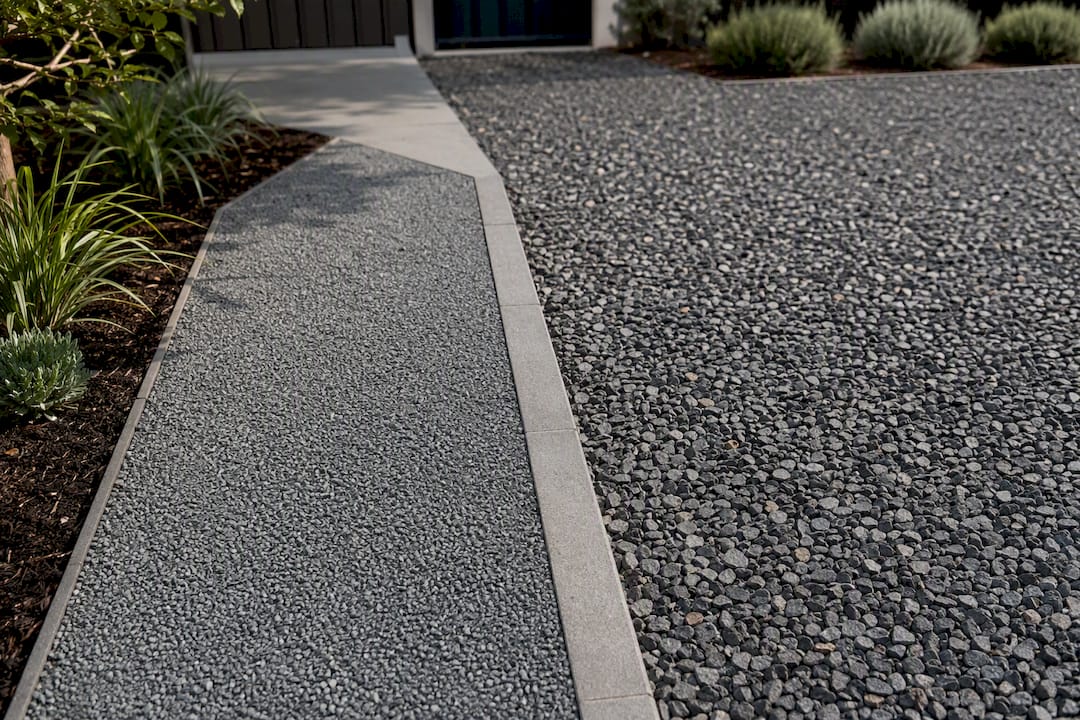
Fire pits and entertaining areas pair naturally with warm hues, rust, gold, terracotta, that echo flame and firelight rather than fighting it. Water features and meditation corners lean the other way, with cool grays or white brightening the space and reinforcing a sense of calm. For borders and accent bands, a narrow strip of contrasting or variegated stone frames garden beds without needing a hard structural edge, and it’s one of the simplest ways to boost curb appeal on a modest budget.
Does rock color change over time?
Yes, and the direction it changes depends entirely on the material. Natural stone weathers slowly and predictably: sun exposure mutes bright pigments a little, mineral deposits and dust settle into surface texture, and granite or basalt barely shift at all over a decade because their color comes from stable mineral content rather than a coating.
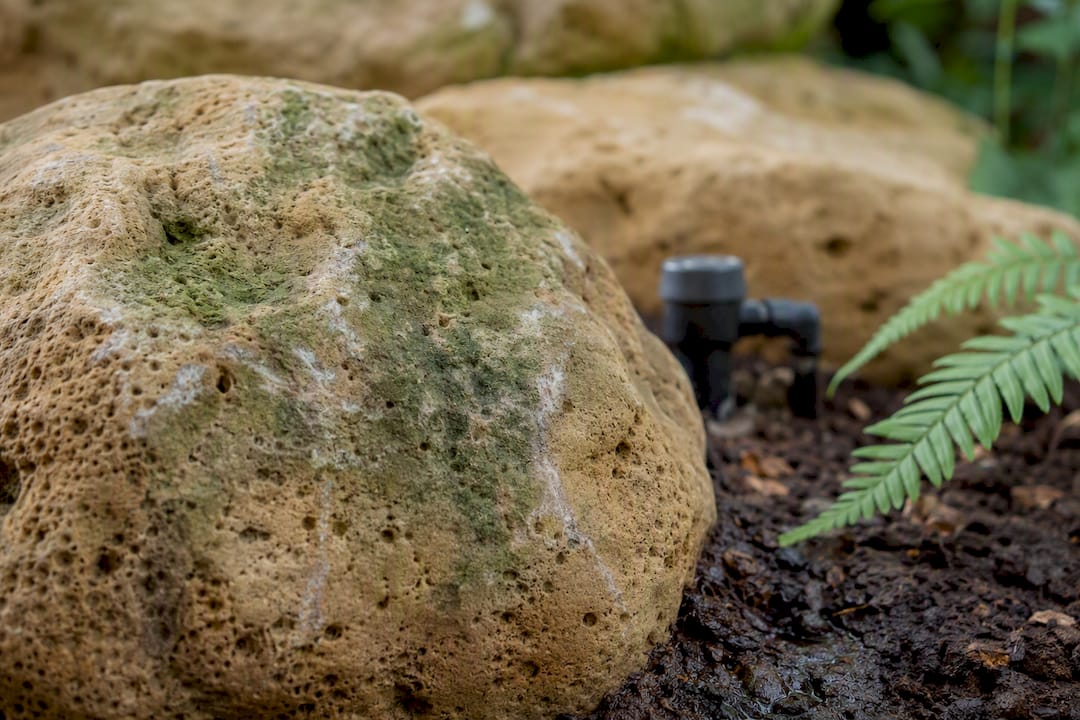
Sandstone and other softer, porous rock tell a different story. They pick up algae, lichen, and mineral staining faster, especially in shaded or damp corners of a yard, and can shift from tan to a mottled gray green within a few years if they’re not occasionally hosed off. Rock sitting near sprinklers or gutter runoff often develops mineral streaking long before the rest of a bed does, which is worth factoring in if you’re planning irrigation nearby.
Dyed gravel is the real risk. Because its color sits as a surface coating rather than coming from the mineral itself, UV exposure and foot traffic wear it unevenly, leaving patches that look freshly colored next to patches that have gone chalky or faded. That patchiness is the biggest giveaway that a gravel was dyed rather than natural, and it’s a strong argument for sticking with naturally colored stone if you want your yard to look the same in year eight as it did in year one.
None of this means rock color is a lost cause over time. It means the weathering pattern is predictable enough to plan around: expect natural stone to mellow slightly, expect porous stone to need occasional cleaning, and expect dyed material to eventually need replacing if you want consistent color.
Can you find every rock color locally, or do some need to be sourced in?
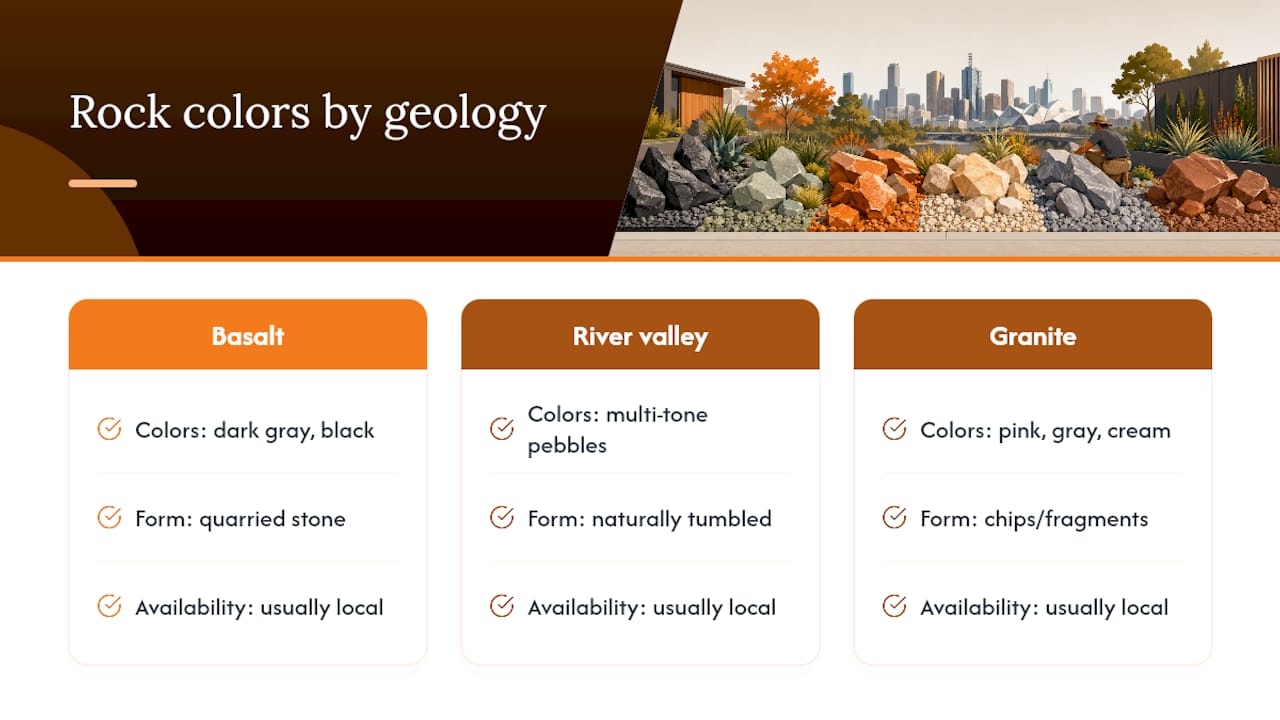
Availability varies more than most homeowners expect. Rock color and type often trace back to regional geology: areas near basalt flows have easy access to dark gray and black stone, river valleys tend to supply naturally tumbled multi-tone pebbles, and regions with granite bedrock offer pink, gray, and cream chips without much shipping markup.
That regional pattern matters for cost and lead time. A color that’s locally quarried is almost always cheaper and faster to get than one trucked in from another region, since freight on heavy bulk material adds up quickly. If you’ve fallen for a specific shade that isn’t native to your area, ask your supplier whether it’s stocked regularly or brought in on request, because “special order” gravel usually costs more and takes longer to arrive.
It’s also worth asking directly where a supplier’s stone comes from. Reputable yards can tell you the quarry or source region for their rock, which matters both for color consistency between deliveries and for confirming you’re getting natural stone rather than a dyed substitute. Buying locally sourced rock, where the color genuinely occurs in the region’s geology, tends to be both the more affordable option and the one most likely to match other natural stone features already in your yard.
Balancing beauty and practicality
Bold, trendy rock colors photograph well and lose their appeal fast. The choices that actually hold up over years of Melbourne weather and daily use are usually subtle: natural variegation, a gray with warm undertones, a blend that hides dust instead of showing it. Longevity and low upkeep should filter every color decision before looks do.
— MYBMC
Get the right rock color installed, not just picked
Picking a color on a screen is easy. Getting it to look right once it’s spread across your yard, holding its line along a bed, sitting flush against a retaining wall, is where most DIY rock jobs go wrong. Rokworx supplies decorative rock, garden stone, and pebbles across Melbourne, and handles the installation side too, including rock wall and retaining wall builds where color and structure both need to hold up for decades.

If you’re still deciding between a warm terracotta blend and a cool gray granite, request washed samples before you buy in bulk. Rokworx can also walk you through which rock works best for a retaining wall if your project involves more than a decorative bed. Get in touch for a quote, or browse the project gallery to see how different rock colors look once they’re actually installed in a Melbourne yard.
Sources
- How to clean garden stones (Airtasker guide)
- Decorative Gravel: Choosing the Right Color and Size for Your Summer Garden


9 Comments
vnsc68
I love how easy it is to navigate through the different games. Everything is organized and the loading times are minimal. A solid choice for everyone. Check out vnsc68
jlbossapk
This analysis is solid, but I wonder how the volatility data translates across different game types? Seems like the structured approach they mention is key, especially when checking out jlboss apk app download. Gotta compare those risk profiles!
kirkiriyabet
Such a vibrant community and a great selection of markets. It is rare to find a site that balances quality and speed so well. Cheers to kirkiriyabet.
schaeferhundblutlinien
Reinrassige Deutsche Schäferhundwelpen europaweit verfügbar 🐕🦺
ragsiamglanz
Ragdoll-, Siam- & Ragamese-Kätzchen europaweit🐱
imperiumvans
Own the Road. Command the Water
papageienparadies
Europas Premium-Papageien aus Hausaufzucht 🦜
asia128login
I’ve been looking for a reliable platform for a while and this one really delivers. The interface is smooth and the payouts are fast. Definitely check out asia128login for a great experience.
au88quayhu
AU88Quayhu, gotta love that name! Seems mainly slots-focused which is my jam. Gonna spin some reels and hope I hit the jackpot! Let the good times roll! au88quayhu