

Yes, a retaining wall and a mature tree can share the same yard for decades, but only if you protect two things during design and construction: the drainage system and the Critical Root Zone. Root pressure and blocked ag-drain lines account for most failures on tree-heavy sites, not simple wall weakness. If large roots are anywhere near the dig line, get an arborist and an engineer involved before the first shovel goes in.
TL;DR:
- The Critical Root Zone distance should be at least 1.5 meters for small trees and up to 8 meters for large mature trees, especially on reactive clay soils.
- Pier-and-panel construction allows roots to pass underneath without damaging the wall, making it suitable for tree-heavy sites with extensive root systems.
- Installing rigid HDPE root barriers extending at least 600 millimeters below the drainage pipe effectively deters roots from infiltrating and clogging drainage systems.
- Segmental block and rock walls are more tolerant of ground movement caused by roots, whereas poured concrete is less flexible and prone to cracking.
- Regular inspection of weepholes after heavy rain helps detect early signs of drainage blockage caused by root infiltration or soil heave.
Table of Contents
- How Tree Roots Damage Retaining Walls
- Safe Distances: Estimating the Critical Root Zone
- Design Options That Let Roots and Walls Coexist
- Protecting Drainage: Root Barriers and Backfill Detailing
- Working With Trees Already on Site
- Choosing Materials That Tolerate Root Activity
- Maintenance Checklist for Walls Near Trees
- What Rokworx Has Learned Building Rock Walls Near Root Systems
- Our Take on Balancing Root Protection and Wall Durability
- Get a Site Assessment Before You Build Near a Tree
- Sources
- FAQ
How Tree Roots Damage Retaining Walls
Roots attack a wall two different ways, and they rarely announce themselves early. The first is brute mechanical force: a root thickens over years, pushes against a footing or panel, and eventually cracks concrete or shoves segmental blocks out of alignment. You’ll often see a slight bulge or a stair step in the block courses long before anything looks like an emergency.
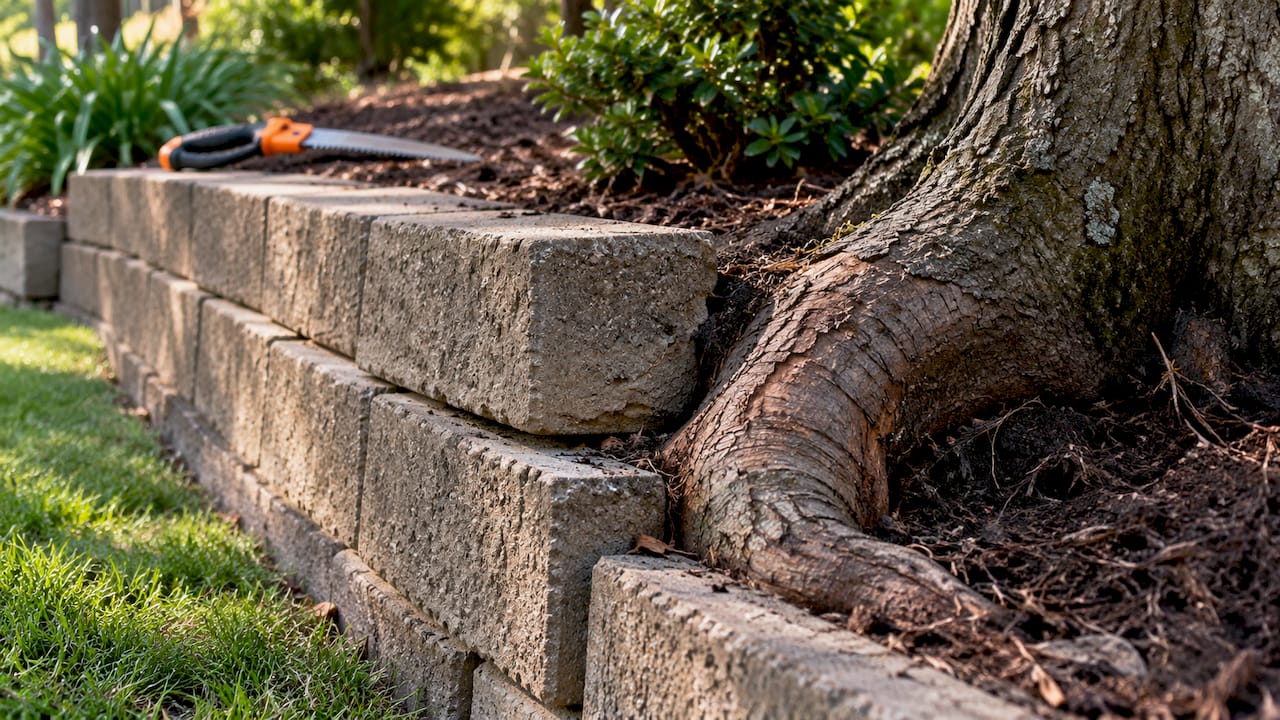
The second mechanism does more damage and gets noticed later. Fine roots chase moisture into the gravel backfill and invade the ag-drain and filter fabric, clogging the pipe and choking weepholes. Once water can’t escape, hydrostatic pressure builds behind the wall. That pressure, not the root itself, is what actually pushes a wall over. Root infiltration of drainage systems is often the more damaging failure mode compared to direct root pressure, according to contractor experience with retaining walls near trees.
There’s a third, less obvious risk on reactive clay soils. A mature tree draws moisture out of the ground year round, keeping clay shrunk and stable. Remove that tree and the clay rehydrates, swells, and can heave a wall that had stood undisturbed for years.
- Cracked panels or displaced blocks near the tree’s canopy line
- Reduced weephole flow after rain, signaling a blocked drain
- Soil heave or wall movement months after a nearby tree is removed
Safe Distances: Estimating the Critical Root Zone
The Critical Root Zone, or CRZ, is the area around a tree where roots are dense enough that digging inside it risks the tree’s stability and the wall’s footing. A simple field method: measure trunk diameter at chest height, then allow roughly one foot of radius for every inch of diameter. It’s a rough tool, not a survey, but it gets you in the right ballpark before you call a professional.
Distance from the wall footing to the trunk should scale with the tree’s mature size:
- Small trees (mature height under 5 meters): keep footings at least 1.5 meters clear.
- Medium trees (5 to 10 meters mature height): allow 3 to 4 meters.
- Large trees (over 10 meters mature height): allow 5 to 8 meters.
These rule-of-thumb distances widen further on reactive clay, where root systems spread aggressively chasing subsurface moisture. When a straight wall run would cut through the CRZ, curve the footprint or offset it around the tree rather than forcing a straight line through root territory.
Design Options That Let Roots and Walls Coexist
Pier-and-panel construction is the standout option for tree-heavy sites. Instead of one continuous footing that severs everything in its path, piers go down at intervals and panels span between them, leaving gaps where roots can pass underneath largely undisturbed. Pier spacing can be engineered to accept the additional load a tree places on a wall, called surcharge, without forcing invasive root removal.
Tree wells solve a different problem: grade changes that would otherwise bury the root collar or trunk flare. A well is a low retaining structure built around the trunk itself, holding the original grade at the tree while the surrounding ground is raised or lowered.
Segmental block systems tolerate minor ground movement better than poured concrete because each block can shift slightly without cracking the whole run, and a damaged section can be pulled and replaced without demolishing the wall. Poured concrete resists load well but has no give. Once a root pushes hard enough, it cracks rather than flexes.
- Curve or offset the wall footprint to skirt the CRZ instead of cutting through it
- Choose pier-and-panel where major roots are known to cross the wall line
- Use tree wells wherever finished grade would bury the trunk flare
- Favor segmental block over poured concrete where root activity is likely
Pro Tip: If an arborist confirms significant surcharge load from a leaning or heavy-canopy tree, ask your engineer to design for that load explicitly rather than hoping the footing handles it by default.
Protecting Drainage: Root Barriers and Backfill Detailing
Drainage failure kills more walls than root pressure alone, which is why the backfill detail matters as much as the wall face. Inadequate drainage causes leaning, bulging, and eventual collapse more often than the roots themselves.
Rigid HDPE root barriers outperform geotextile fabric when aggressive species are nearby, because fabric can eventually be pierced or grown around while solid HDPE forces the root to redirect. Barriers should extend at least 600 millimeters below the base of the ag-drain, since a shallow barrier just gives roots an easy path underneath it.
- Backfill with clean, free-draining gravel, never native clay or topsoil
- Run the ag-drain along the base of the wall with a consistent fall to daylight or a stormwater connection
- Space weepholes evenly and keep them clear during construction, not just after
- Inspect weepholes after every heavy rain event for the first two seasons
Roots that bridge over a barrier or find a gap at a joint can still reach the drain line years later, so a one-time installation isn’t a lifetime guarantee. Treat the barrier as a strong deterrent, not a permanent seal.
Working With Trees Already on Site
If a wall has to go in near an established tree, don’t guess where the major roots run. An arborist report combined with an air spade, which blasts soil away with compressed air instead of cutting through roots, lets you see exactly what you’re dealing with without machinery inside the CRZ.
- Get an arborist assessment before design work locks in the wall’s footprint.
- Expose roots with an air spade rather than an excavator bucket when digging inside the CRZ.
- Limit root pruning to well under 25 percent of major roots, and only after professional assessment of which roots are structurally critical.
- Water and mulch the root zone after any pruning to reduce transplant-style stress on the tree.
Removing a large tree outright carries its own risk on reactive clay: the soil can rehydrate and swell once the tree stops drawing moisture from it, which can heave a wall that was previously stable. Get engineering input before removing anything substantial near an existing structure.
Choosing Materials That Tolerate Root Activity
Segmental block remains the most forgiving option on root-affected ground. Individual units flex slightly with minor movement, and a single damaged course can be replaced without touching the rest of the wall. Rock walls offer a similar tolerance, plus a natural look that suits garden settings, provided the base rock is set correctly and not just stacked loose. Poured concrete delivers real strength but almost no give, so it’s better suited to sites well clear of any CRZ.
- Segmental block: repairable, flexible, easy to match if you need a partial rebuild later
- Rock retaining walls: tolerant of minor ground shift, suits naturalistic landscaping
- Poured concrete: strongest option, but cracks rather than flexes under root pressure
For walls over roughly one meter, or anywhere tree surcharge is a factor, geogrid reinforcement in the backfill adds real holding power. Footing depth and base compaction still matter near roots. A base that’s under compacted will settle unevenly no matter how good the material above it is.
Maintenance Checklist for Walls Near Trees
Weephole discharge after heavy rain is the single best early warning sign a homeowner can check without any tools. Strong, steady flow means the drain is clear. Reduced or absent flow after a downpour usually means roots have partially blocked the line, and it’s worth booking a CCTV drain inspection before the blockage gets worse.
- Watch for gradual leaning, bulging, or blocks shifting out of alignment near the tree’s canopy
- Check for new surface cracks radiating from the tree zone after storms
- Book a professional inspection any time a nearby tree gets a major prune or is removed
Root growth into drainage lines tends to be gradual over multiple seasons rather than sudden, so a wall that looked fine last year can show clear warning signs this year if weepholes were never checked.
What Rokworx Has Learned Building Rock Walls Near Root Systems
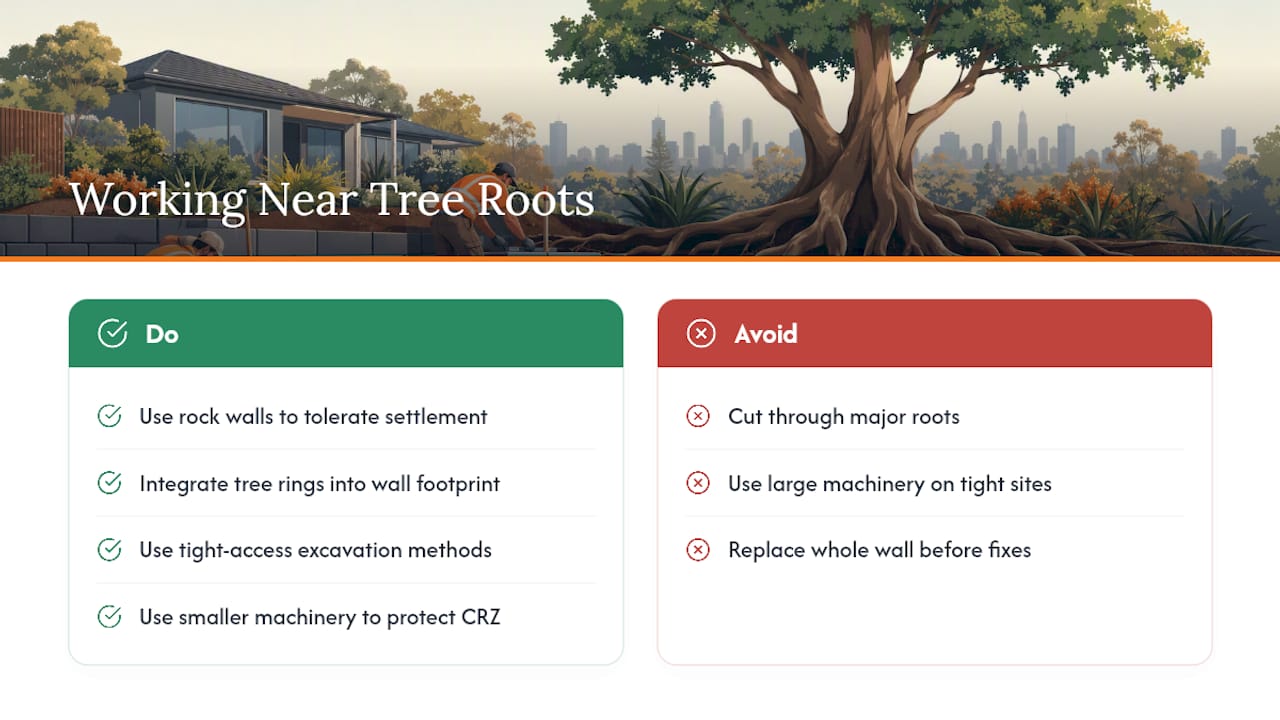
Rock walls tend to be a preferred choice on tree-heavy blocks because individual rocks can settle into minor ground movement instead of cracking, and tree rings can be integrated into the wall footprint to keep the trunk flare clear. On tight sites, tight-access excavation with safe methods using smaller machinery lets us work around major roots instead of through them, protecting the CRZ while still getting a solid footing down. When an existing wall has been compromised by roots, localized drainage rebuilds or root barrier retrofits can sometimes fix the problem without needing to replace the entire structure.
Our Take on Balancing Root Protection and Wall Durability
We design every wall near a tree with drainage and the Critical Root Zone as the starting point, not an afterthought bolted on after the layout is fixed. That order matters. A wall designed around the roots first almost never needs the kind of emergency drainage rebuild that a wall designed around convenience does five years later. Bringing an arborist and an engineer in early costs less than fixing heave or hydrostatic failure after the fact, and it usually saves the tree too.
— MYBMC
Get a Site Assessment Before You Build Near a Tree
Some companies build rock retaining walls and handle the excavation that goes with them, which allows root protection and drainage detailing to be coordinated together rather than divided between separate contractors. A thorough on-site assessment of root zones, soil conditions, and drainage paths before recommending a wall type helps inform whether a design will hold up against growing roots.

If you’ve got mature trees near a slope or retaining wall project anywhere across Melbourne, request an on-site assessment before locking in a design. Browse rock wall design ideas for inspiration, then get in touch through our rock walls page to book a site visit and a straight answer on what your trees and soil will actually allow.
Sources
- Retaining Walls & Trees: Root Damage Guide | RetWall
- Key concepts for tree-friendly design | DeepRoot
FAQ
Is It Okay to Plant Trees Near a Retaining Wall?
Small, non-invasive species can work if planted well outside the wall’s footing and away from drainage lines, but large or fast-growing trees should go far enough away to keep their mature root spread clear of the wall entirely.
How Close Is Too Close for a Tree Next to a House or Wall?
It depends on mature size and soil type: keep small trees at least 1.5 meters back, medium trees 3 to 4 meters, and large trees 5 to 8 meters, with wider margins on reactive clay soils.
How Long Do Tree Roots Take to Decompose in the Ground?
Root decomposition timelines vary widely by species and soil moisture, but large structural roots can take several years to fully break down, sometimes leaving voids that cause soil settlement near a wall long after a tree is removed.
Which Trees Should Not Be Planted Close to a House or Wall?
Fast growing, water hungry species with aggressive lateral root systems are the riskiest choice near foundations and walls, and a local arborist can confirm which species on your block fall into that category.
Can a Rock Retaining Wall Handle Nearby Tree Roots Better Than Block or Concrete?
Rock walls tolerate minor ground shift well because individual rocks settle rather than crack, which is why Rokworx often recommends them on sites with established trees nearby.


9 Comments
17777betapp
The app version is just fantastic. It is way more convenient than the browser and the graphics are crisp. Definitely download 17777betapp now.
homeraisedparrots
Home Raised Parrots – Amazon Parrots Guide
pinballmarket
Premium Pinball,
Arcade & Foosball Machines Canada🚚
pomchipals
Tiny PomChi Puppies Ready for Loving Homes
euroketarelief
Eu Pharma
PomskyNest
https://PomskyNest.com Pomsky Puppies
shihtzulieblinge
Reinrassige Shih-Tzu-Welpen europaweit adoptieren🐶
2uuu88viplogin
The VIP experience is legit. I feel like a valued player every time I log in. Big thanks to 2uuu88viplogin for the amazing service.
idturbo88
The speed of the site is amazing, just like the name suggests. No glitches and the graphics are sharp. I am really enjoying my time at idturbo88.