

A site cut is the controlled reshaping of a backyard to create a stable, well-draining platform for building or landscaping. You need one when your block slopes, you’re removing an old pool, installing heavy hardscape like a retaining wall or paved patio, or fighting chronic pooling near the house. Skip the checks first (permits, geotech, utility marking) and even a small backyard job can turn expensive fast.
TL;DR:
- Most backyard site cuts cost more if access is tight, rock removal is involved, or more spoil needs trucking off-site, often extending project timelines to several weeks.
- Accurate surveys, utility marking, and geotechnical assessments are essential steps that prevent long-term issues like wall leaning or poor drainage, yet are often overlooked.
- Proper grading requires at least a 2% fall around foundations and may need additional drainage features like French drains or catch basins on flat or heavy clay soils.
- Small regrades may be manageable DIY, but jobs involving slopes, rocks, or structural fills demand professional machinery and expertise to avoid future settlement or instability.
- Contractors must provide detailed quotes including compaction standards and utility clearance; vague quotes or lack of documentation are red flags for costly rework later.
Table of Contents
- What Is a Site Cut and Why Would You Need One?
- How Does the Site Cut Process Actually Work?
- Do You Need Council Approval for a Backyard Site Cut?
- What Slope and Drainage Should You Aim For?
- How Much Does a Backyard Site Cut Cost and How Long Does It Take?
- Should You DIY the Cut or Bring in an Excavator?
- Safety and Best Practices to Follow On Site
- The Rokworx Approach to Backyard Site Cuts
- Why Most Backyard Grading Advice Undersells the Planning Stage
- Get a Site Cut Quote From a Melbourne Earthmoving Crew
- Sources
- FAQ
What Is a Site Cut and Why Would You Need One?
Every site cut works on the same principle: cut, fill, and balance. You remove soil from the high side of a slope (the cut) and use it to build up the low side (the fill), aiming for a level or evenly graded surface without hauling in truckloads of extra material. Done right, the volume of dirt cut roughly equals the volume needed for fill, which is what keeps costs down.
Backyard projects call for a site cut for a few practical reasons:
- A stable, level platform for a shed, deck footing, patio slab, or granny flat
- Better drainage, since a flat or poorly graded yard holds water against fences and foundations
- Usable outdoor space carved out of a slope that was previously too steep to walk on comfortably
- A base course for a retaining wall or terraced garden bed
Homeowners most commonly reach for a site cut after buying a sloped block, before a pool installation or removal, or when planning a major landscaping overhaul that includes rock walls or new turf. If your yard already pools water after rain, or one corner sits noticeably lower than the rest, that is usually the first sign a cut and regrade is overdue.
How Does the Site Cut Process Actually Work?
A backyard site cut runs through five distinct phases, and skipping any one of them is where most DIY regrades go wrong.
- Survey and mapping. A contractor sets a benchmark point, then uses a rotary laser level and a grid method, staking out the yard and shooting elevations at each point to calculate exactly how much material needs to move. This is also the stage to sketch a simple yard map noting fences, existing slopes, and wet patches, since it helps decide what stays and what goes before machinery arrives.
- Utility marking and site stripping. Before any digging, underground services get marked. Topsoil, usually the top 4 to 6 inches, gets stripped and stockpiled separately rather than buried, since organic matter left under fill decomposes and causes settling later.
- Bulk excavation. This is where the cut-and-fill math gets tested against reality. Rock, old concrete, or unexpected fill material can throw out volume calculations, and spoil either gets reused on-site or trucked off.
- Compaction in lifts. Fill goes down in thin layers, compacted near optimum moisture before the next layer goes on. Mechanical compactors only reach the upper portion of a loose lift, so staged compaction is what prevents the yard from sinking unevenly six months later.
- Final trim and handover. Grades get checked against the design fall, drainage points confirmed, and topsoil reinstated over the compacted base.
Pro Tip: Ask your contractor to show you the grid readings before excavation starts. If they can’t produce elevation numbers, they’re eyeballing it, and eyeballed grading is exactly what leads to a yard that ponds water in one corner two years later.
Do You Need Council Approval for a Backyard Site Cut?
Whether you need a permit depends on the scale of the cut, its depth, and its proximity to boundaries or easements. Local planning frameworks make it clear homeowners should check council rules and local planning schemes before any major landworks, since even backyard-scale jobs can trigger a development application if they affect drainage easements, retaining structures over a certain height, or sit near a boundary.
A few checks are worth doing before you book an excavator:
- Confirm with your council whether your planned cut depth or retaining wall height needs approval
- Get a geotechnical report for anything involving significant cuts near a boundary, a slope over roughly 1 in 4, or a retaining wall taller than about 600mm to 1 meter, since a geotech assesses soil type, bearing capacity, and slope stability before you commit to a design
- Arrange utility locating (call before you dig) so gas, water, and electrical lines are marked before machinery touches the ground
- Verify the contractor’s license and insurance through a state practitioner register, which lets you check credentials and disciplinary history before signing anything
Skipping the geotech step on anything beyond a minor regrade is the single most common regret homeowners report after the fact, mostly because slope failures and wall movement show up months after the job wraps, not during it.
What Slope and Drainage Should You Aim For?
Grading exists to solve one problem: moving water away from where you don’t want it. Practical slope guidance commonly used in residential grading calls for a fall of at least 2% (roughly a 1 inch drop per 4 feet) directly around foundations, tapering to a gentler grade further into the yard.
The math that matters: a yard sloping even slightly toward the house, rather than away from it, is what drives most backyard drainage complaints. Immediate slope near foundations is the single biggest factor in whether water pools against a wall or clears the site.
Grading alone doesn’t always solve the problem, particularly on flat blocks or heavy clay soils where even a correct fall drains too slowly. That’s when engineered drainage earns its keep:
- French drains for subsurface water intercepted along a slope or wall line
- Catch basins at low points to collect surface runoff before it reaches a structure
- Dry wells where water needs somewhere to go on a site with no street drainage connection
Pairing grading with these features is standard practice rather than a fallback, especially on modest slopes where a fall alone won’t shift water fast enough during heavy rain. How you grade also shapes what grows afterward. Lawns tolerate a gentle fall fine, but garden beds on a steep grade wash out without retaining edges, and any retaining wall built on unstable or poorly compacted fill is a wall waiting to lean within a few years.
How Much Does a Backyard Site Cut Cost and How Long Does It Take?
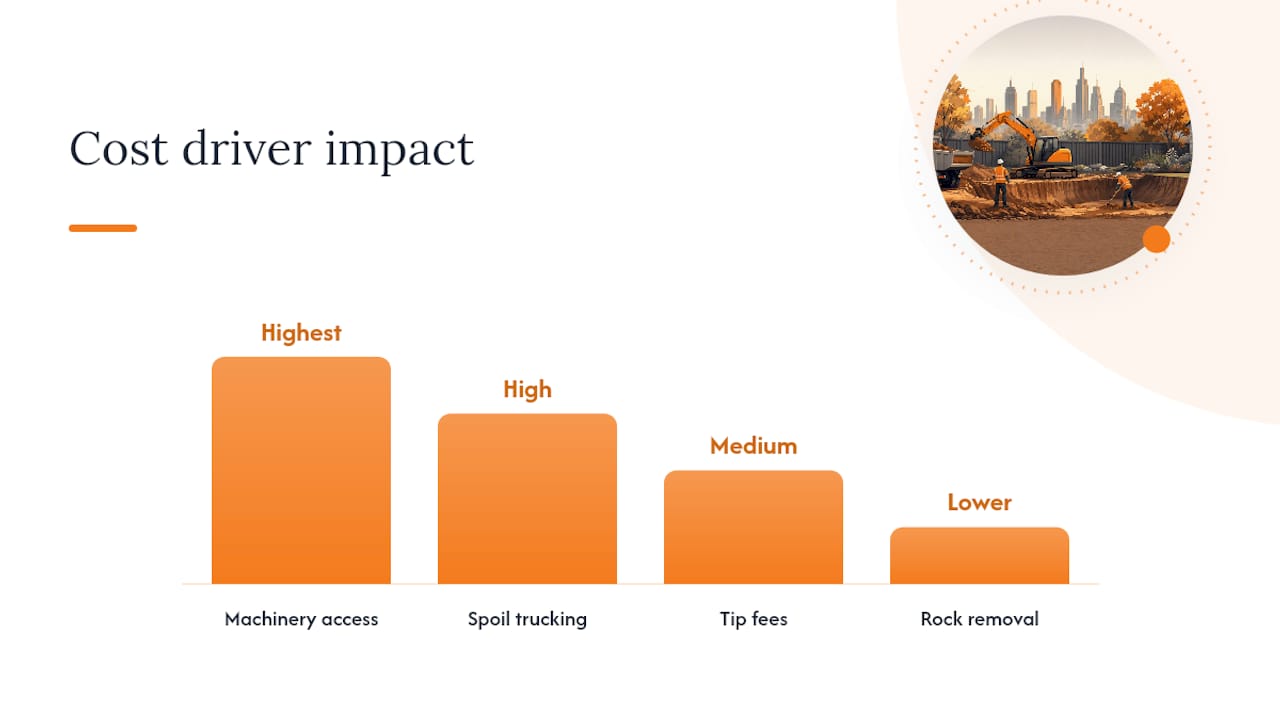
Cost swings widely based on access, soil type, and what has to leave the site. A straightforward regrade on an accessible block sits at the low end; a cut involving rock breaking, tight machine access, or heavy haulage climbs quickly from there. The biggest cost drivers, in order of impact, are usually access for machinery, how much spoil needs trucking off-site, tip fees, and whether rock removal is involved.
Most backyard site cuts run somewhere between a few days and two to three weeks, depending on scope. A simple regrade for turf prep might wrap in a day or two. A full cut-and-fill job ahead of a retaining wall or pool fill-in, including compaction testing and drainage work, often stretches closer to the two to six week range covered in Rokworx’s cut and fill planning guide.
A few things push the estimate up after the quote is signed:
- Unexpected rock or buried debris that wasn’t visible during the initial site walk
- Asbestos-containing material in older properties, which requires specialist handling and disposal
- Drainage work added mid-project once the contractor sees how water actually moves on-site
Smart contractors keep costs down by reusing excavated material on nearby jobs instead of trucking it to a tip and buying fresh fill, a sequencing trick that can meaningfully cut haulage and material costs on the right project.
Should You DIY the Cut or Bring in an Excavator?
A small, flat-ish job, like leveling a garden bed or minor lawn regrade with a shovel and a wheelbarrow, is reasonable to tackle yourself. Anything involving a slope steeper than roughly 1 in 4, rock, structural fill for a wall or slab, or machinery access through a tight side gate is a job for a professional excavator.
Before you sign a quote, run through this checklist:
- Ask for proof of current insurance and license, then cross-check it against the state practitioner register.
- Ask how many similar backyard cuts they’ve handled and request references or photos.
- Confirm who arranges utility locating and geotech assessment, and whether that cost is included.
- Ask what compaction standard they work to and whether they test it, or just eyeball the fill.
- Get written confirmation of machinery access requirements, since a mini excavator through a narrow side gate changes both the timeline and the price.
Pro Tip: A quote with no mention of compaction specs or utility clearance is a quote worth questioning. Those two omissions are the most common source of expensive rework six to twelve months down the track.
Vague scopes, verbal-only quotes, and contractors who can’t answer a direct question about soil compaction are the clearest red flags. If a quote reads like a single line item with no phase breakdown, ask for a rewrite before you commit.
Safety and Best Practices to Follow On Site
Get utility services marked before anything else, and keep manual digging shallow near marked lines rather than trusting memory or old plans. Strip topsoil before bulk excavation and stockpile it separately. Never bury organic material under structural fill, and build fill in compacted lifts rather than one deep pour.
Protect fences, established trees, and garden features with clear exclusion zones while machinery is on site, and confirm with your contractor exactly where equipment will enter and exit before the first day of work.
The Rokworx Approach to Backyard Site Cuts
Rokworx works across earthmoving and excavation, rock walls, and retaining wall construction, which means the same crew scoping your cut also understands what the finished grade needs to support. That matters most on jobs where a site cut is really step one of a bigger plan, like a terraced yard or a wall-backed garden bed, rather than a standalone regrade. Rokworx also shares practical backyard landscaping ideas to help homeowners plan what comes after the dirt work, along with cost and time guidance for cut-and-fill planning tailored to Australian yards and soil conditions.
Why Most Backyard Grading Advice Undersells the Planning Stage
Most guides to leveling a backyard spend their word count on the fun part: the excavator, the grading, the finished slope. The planning stage, geotech checks, utility marking, council rules, gets a sentence or two before the article moves on. That ordering is backwards for anyone actually about to dig.
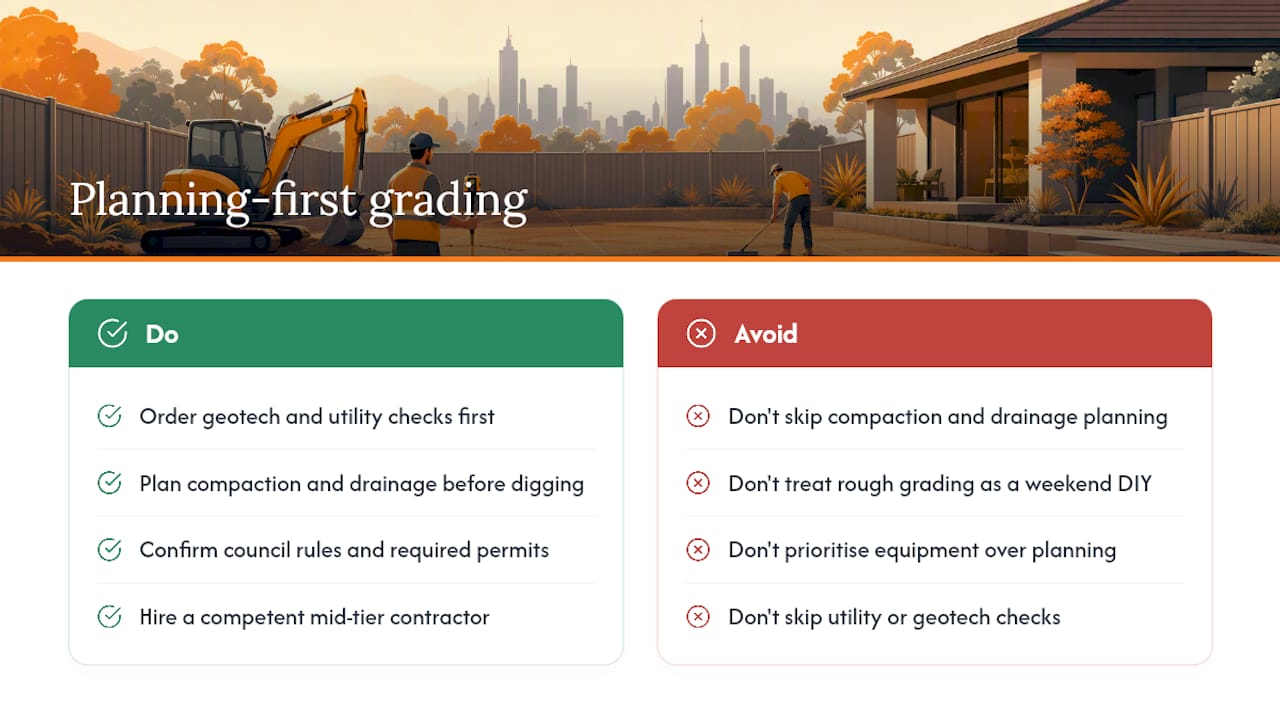
The research on grading failures backs this up. Skipping compaction and drainage planning creates problems that don’t show up until months later, when a wall starts leaning or a corner of the yard won’t drain no matter how many times it gets top-dressed. Treating land clearing and rough grading as a weekend DIY job is where most long-term stability and drainage problems start, not in the excavation itself.
If there’s one thing worth prioritizing first, it’s the geotech and utility checks, not the equipment. A homeowner who gets those right and hires a mid-tier contractor will outlast a homeowner who skips them and hires the best excavator in the state. The dirt work is forgiving. The planning almost never is.
— MYBMC
Get a Site Cut Quote From a Melbourne Earthmoving Crew
Rokworx handles the full scope this article just walked through: earthmoving and excavation and site cuts, rock supply, and retaining rock wall construction for backyards that need more than a shovel and a weekend. Where a general regrading crew stops at the cut, Rokworx carries the job through to the finished wall, terrace, or rock feature, which saves you from managing two separate contractors and two separate timelines.

Before requesting a quote, have a few things ready: site access details (gate width, slope, distance from the street), photos of the area, rough dimensions of the cut you’re planning, and any known issues like old pool shells, tree roots, or drainage complaints. A licensed and insured earthmoving crew can provide a site visit to confirm scope and cost before anything gets signed. Get in touch through Rokworx to book a site assessment.
Sources
- Planning Queensland — local planning schemes
- RELN — drainage and landscape engineering resources
- LawnsGuide — Leveling backyard step-by-step
- VBA practitioner register — practitioner detail
- Ari’s Excavations — Pool fill-in with site cut
FAQ
How Much Does a Site Cut Cost?
Cost depends heavily on access, soil type, and haulage distance, with rock removal and tip fees usually driving the biggest jumps in price. For a fuller cost breakdown by project scope, see Rokworx’s cut and fill cost guide; Rokworx itself does not publish a flat rate since every backyard site differs, and quotes are available on request.
How Long Does a Site Cut Take?
A simple backyard regrade can wrap in a day or two, while a full cut-and-fill job with compaction testing and drainage work typically takes two to six weeks. Access difficulty, rock content, and weather delays are the main reasons a timeline stretches beyond the initial estimate.
What Does Site Cut Mean in Construction?
A site cut is the excavation and reshaping of ground to create a level or graded platform, following the cut-and-fill principle where soil removed from high points fills the low points. It is standard preparation work before foundations, retaining walls, driveways, or major landscaping.
What Is the Easiest Way to Dig Up Ground?
For small areas, hand tools or a rented mini excavator work fine on flat, rock-free soil. For anything beyond a small garden bed, slope, or job involving structural fill, a professional excavator with the right machinery access is faster, safer, and avoids the compaction mistakes that cause settling later.
Do I Need a Geotechnical Report for a Backyard Site Cut?
You generally need one for significant cuts near a boundary, slopes steeper than roughly 1 in 4, or retaining walls above about 600mm to 1 meter. A geotech report assesses soil type and slope stability, which protects you from costly wall failures or drainage issues down the line.


8 Comments
reliefmedspharma
Order Pure Molecule relief Meds Canada ✅
gunnersmart
Buy Sophisticated Hand Guns Now
champion-bulldoggen
Champion-Europäische Bulldoggenwelpen zur Adoption
taktikwacht
Kaufen Sie diskret die besten Handfeuerwaffen in Europa
puremoleculelabs
https://puremoleculelabs.com Molecular Labs
ketamight
https://ketamight.com – Order Ketamine
78winapp
Easy to navigate and very user friendly. Even for beginners, it is a breeze to get started. Big thanks to 78winapp for the great service.
27gcom
A hidden gem for sure. I had a few questions and the support team answered me almost instantly. Great job 27gcom!