

If your Melbourne slope is losing soil, stabilize it now with temporary cover like jute matting, mulch, or sandbags, and stop any concentrated water flow before it cuts a channel. Long term, favor vegetation-based bioengineering wherever the slope allows it, and bring in engineered rockwork with a proper filter layer and drainage where the grade or the risk to structures is too high for plants alone. Melbourne Water treats vegetation as the first line of defense and rockwork as backup protection for banks and beds, and that hierarchy should guide your next move.
TL;DR:
- Proper installation of a granular filter or geotextile layer beneath rockwork is essential to prevent soil migration and ensure the wall’s longevity.
- Choosing a contractor who references Melbourne Water standards, explains drainage plans early, and provides written specifications for filter layers increases the likelihood of a lasting slope stabilization.
- Vegetation-based stabilization requires biannual inspections, especially after heavy rain, while rockwork needs checks for structural movement or soil on the surface, with temporary matting lasting 6 to 18 months.
- Costs and timelines vary widely depending on slope size, access, and chosen method; a site assessment is necessary for accurate pricing and scheduling, especially before winter rains.
- Combining plant cover with engineered protection, such as toe anchoring and filter layers, is the most effective approach to prevent slope failure in Melbourne’s variable soils and weather patterns.
Table of Contents
- Why the Filter Layer Under Rockwork Matters More Than the Rock
- How Do You Choose a Slope Stabilization Contractor in Melbourne?
- What Maintenance Does a Stabilized Slope Actually Need?
- What Do Melbourne Slope Erosion Projects Cost and How Long Do They Take?
- How Melbourne’s Climate and Soil Types Drive Erosion Risk
- What Permits and Regulations Apply to Slope Work in Melbourne?
- When Is the Best Time to Start Slope Erosion Control in Melbourne?
- Rokworx’s Local Perspective on Melbourne Slope Work
- Get a Site Assessment for Your Melbourne Slope
- Sources
- FAQ
Why the Filter Layer Under Rockwork Matters More Than the Rock
Most rockwork failures on Melbourne slopes have nothing to do with the rock itself. They come from what’s missing underneath it. Rock placed directly onto exposed clay or sandy loam looks stable for months, sometimes years, then one heavy winter storm washes the fine soil out from between the gaps and the whole structure slumps.
Melbourne Water’s rockwork standards require angular, well-graded, interlocked rock with sealed voids and toe protection at the base of the slope. Underneath that rock, a graded granular filter or a non-woven geotextile layer has to sit between the soil and the stone. That layer stops fine particles from migrating up through the rock gaps while still letting water pass through and drain away.
Skip it, and you’re building on borrowed time. Installers who cut this step to save a day of labor are the reason so many “new” rock walls around Melbourne start bulging within two or three wet seasons. The filter layer costs relatively little compared to the rock and labor around it, but it’s the single detail separating a wall that lasts decades from one that needs rebuilding.
If you’re getting quotes for rockwork on a slope, ask specifically whether a filter or embedment layer is included and what material it uses. A contractor who can’t answer that clearly probably isn’t specifying one. For a deeper look at how these layers interact with drainage design, Rokworx’s guide to retaining wall drainage covers the practical side of getting water out from behind the structure once it’s built.
How Do You Choose a Slope Stabilization Contractor in Melbourne?
Ask about filter layers first, then move to the rest of the list. A contractor who understands erosion control will talk about drainage before they talk about aesthetics, because a slope that looks good but floods behind the wall is a slope that fails.
Here’s what separates a serious operator from someone who just owns a truck and a few pallets of rock:
- Do they reference Melbourne Water specifications? A contractor familiar with local stormwater standards will design toward them rather than guessing at rock size and grading.
- Can they explain their drainage plan before they quote the rock? Drainage decisions should come first, not as an afterthought once the wall is half built.
- Do they specify plant species suited to your slope’s aspect and soil? Ozbreed’s erosion control palette exists precisely because generic “native mix” planting often fails on steep, exposed cuts.
- What’s their approach to access and site cuts? Tight-access sites around Melbourne’s hillier suburbs need different equipment and sequencing than open blocks.
- Will they put the filter layer, rock grading, and toe protection in writing? A verbal promise disappears the moment something goes wrong.
Get at least two quotes for anything beyond a small residential slope, and be wary of anyone who prices the job without walking the site. Rokworx’s notes on choosing a rock beaching contractor go into more detail on the specific questions worth asking before you sign anything.
What Maintenance Does a Stabilized Slope Actually Need?
Vegetation-based slopes need inspection twice a year at minimum, ideally after the first major autumn rain and again at the end of winter when saturation peaks. You’re checking for bare patches where groundcover hasn’t established, signs of rilling (small channels forming where water concentrates), and any undermining at the base where runoff exits.
Rockwork needs less frequent attention but the checks matter more when something’s wrong. Look for rock movement, gaps opening between stones, or soil appearing on the surface of the rock face, which usually signals the filter layer underneath has failed. Toe erosion at the base of a rock wall is often the earliest warning sign of a bigger structural problem forming behind it.
Temporary matting has a shorter clock. Jute matting typically lasts 6 to 18 months depending on grade and exposure, and it needs checking after storms for pins that have worked loose or overlaps that have lifted. A section of matting that’s ballooned or torn free is doing nothing and needs re-pinning immediately, not at the next scheduled visit.
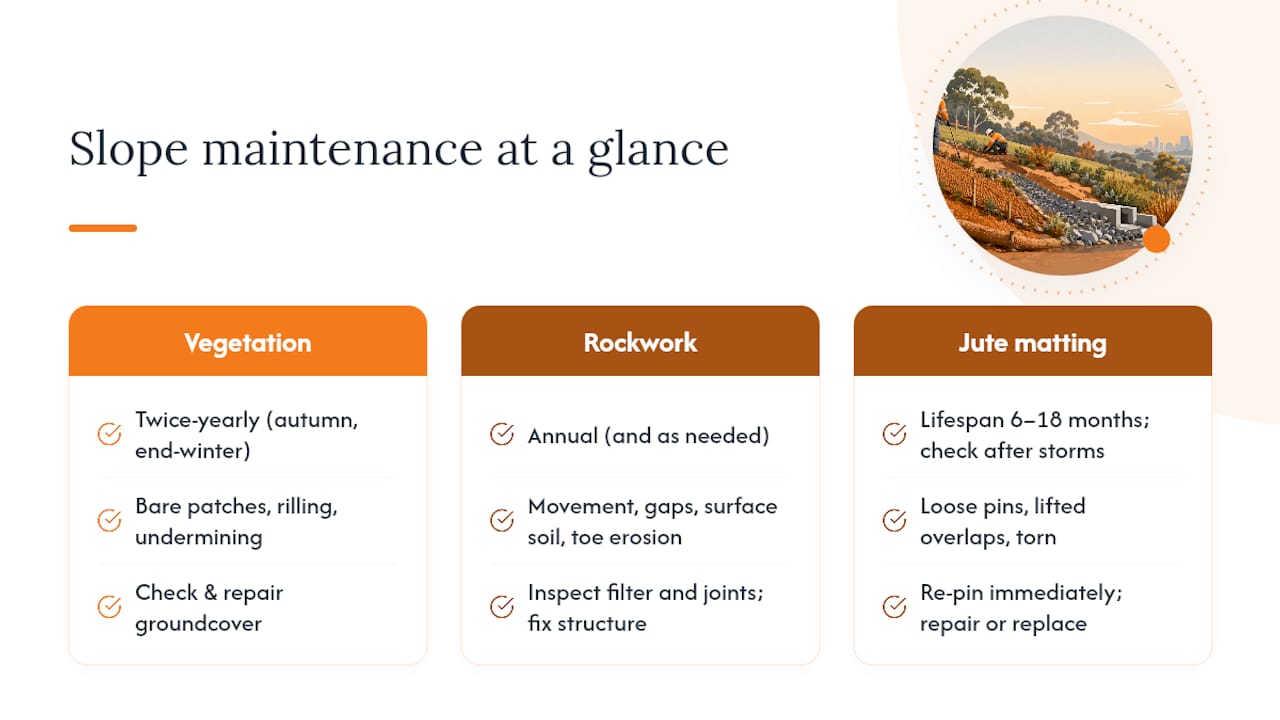
For permanent retaining structures, an annual walk-around covering drainage outlets, weep holes, and joint movement catches most problems while they’re still cheap to fix. Rokworx’s guide on retaining wall maintenance breaks down a practical inspection routine homeowners can run themselves between professional check-ins.
What Do Melbourne Slope Erosion Projects Cost and How Long Do They Take?
Costs vary enormously depending on slope height, access, soil type, and whether you’re doing vegetation, rockwork, or a combination. A straightforward vegetation-based stabilization on a moderate residential slope, with groundcover planting and some temporary matting while it establishes, sits at the lower end of the spectrum and can often be turned around within a week or two of planting, though full root establishment takes a full growing season or more.
Engineered rockwork is a bigger commitment. Rock supply, filter layer installation, and placement on a slope that requires machine access typically run over several weeks once earthmoving and site preparation are factored in. Steep sites with tight access add time and cost because material has to be moved differently, sometimes by hand or with smaller equipment than a straightforward open block would need.
Timing also shifts with the season. Projects scheduled before winter rain need temporary matting installed fast, sometimes within days, to avoid a wet season washing out bare soil before permanent works go in. Projects planned for dry months have more flexibility but still need irrigation for new plantings.
Getting an accurate figure means getting a site assessment, since slope angle, soil composition, and access all move the number significantly. A quote that doesn’t account for filter layers, drainage, and toe protection separately from the visible rockwork is usually missing something.
How Melbourne’s Climate and Soil Types Drive Erosion Risk
Melbourne’s erosion problems come down to a mismatch: intense, short-burst rain events falling on soils that don’t drain evenly. Much of the city sits on basalt-derived clay in the west and sedimentary mudstone and sandstone-derived soils across the eastern and outer suburbs, and both types behave badly under concentrated water flow, just in different ways.
Clay-heavy soils swell when wet and shrink when dry, which opens cracks that channel water straight down into the slope rather than letting it run off evenly across the surface. Once water finds one of those cracks, it undercuts material below and the slope can slump suddenly rather than eroding gradually. Sandier, more friable soils in parts of the outer east and southeast erode differently, washing away grain by grain under sheet flow, especially on newly cleared or recently disturbed ground.
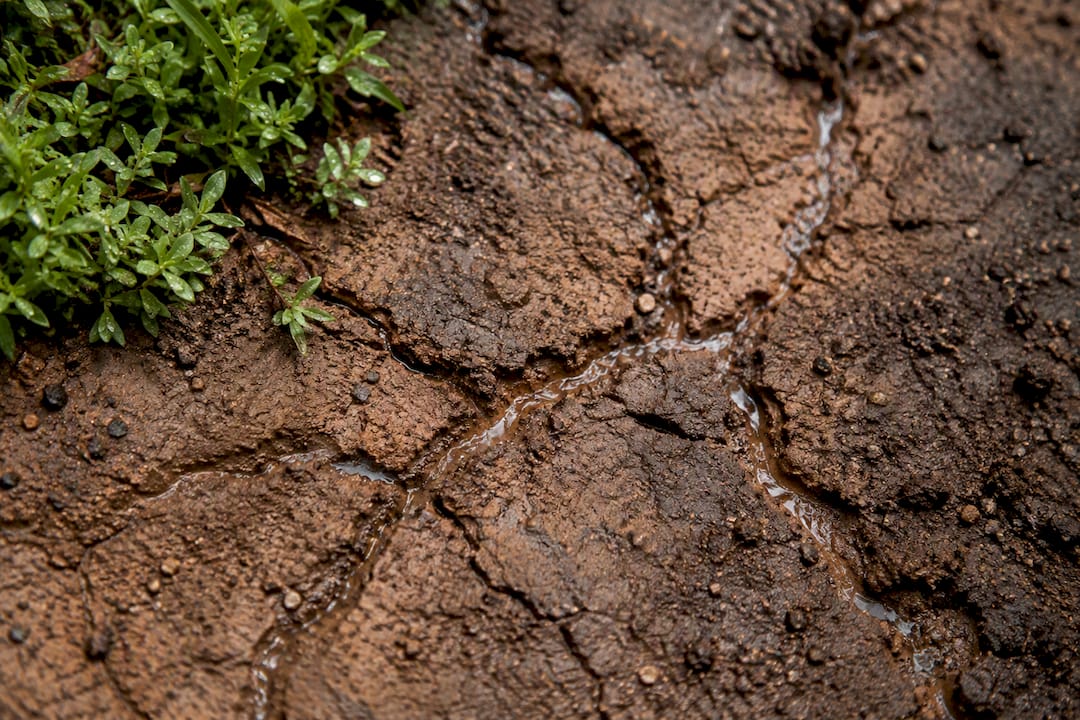
Melbourne’s rainfall pattern makes this worse than a simple annual total would suggest. Storms tend to arrive as short, heavy bursts rather than steady soaking rain, particularly in late summer and early autumn, and that intensity is exactly what strips bare soil fastest. A slope that handles a gentle drizzle fine can lose centimeters of surface soil in one thunderstorm if it’s been left exposed.
This is why bioengineering, using root systems to bind soil and canopy layers to intercept rainfall before it hits the ground, tends to outperform bare engineered solutions on slopes where vegetation can establish. It’s a self-sustaining system rather than a static barrier, and it tends to improve with age instead of degrading.
What Permits and Regulations Apply to Slope Work in Melbourne?
Erosion control work in Melbourne sits at the intersection of a few different regulatory layers, and which ones apply depends on your slope’s location and what you’re building. If your property backs onto a waterway, drain, or Melbourne Water asset, works near that boundary generally require consultation with Melbourne Water before you start, particularly for anything involving rockwork placement, bank reshaping, or drainage modification near a waterway.
Local council planning permits often come into play for retaining walls above a certain height, typically triggered once a wall reaches around one meter, though the exact threshold and any setback requirements vary by council across metropolitan Melbourne. Structural engineering sign-off is commonly required for taller or load-bearing walls, especially where the wall supports a driveway, building foundation, or neighboring property.
Construction sites of any size have sediment and erosion control obligations under general environmental protection requirements, which is where temporary matting and sediment fencing become not just good practice but a compliance necessity while a site is disturbed. Leaving bare soil exposed on an active site without any control measure is one of the more common compliance gaps inspectors flag.
Before starting any rockwork, retaining structure, or significant earthmoving on a slope, check with your local council and, where a waterway is involved, with Melbourne Water directly. A contractor experienced in Melbourne slope work should be able to flag which approvals your specific project needs before quoting the job.
When Is the Best Time to Start Slope Erosion Control in Melbourne?
Late summer and early autumn, before the wet season arrives, is the window that gives new plantings and temporary measures the best chance to establish before heavy rain tests them. Getting groundcover and structural planting in the ground while soil temperatures are still warm speeds root establishment, and Ozbreed’s guidance on layered plant communities notes that faster-establishing groundcover species help lock down surface soil while slower, deeper-rooted plants develop the long-term reinforcement.
Winter is the highest-risk period for erosion damage but the worst time to start new vegetation work, since cold, wet soil slows root growth right when the slope needs it most. If a slope is actively eroding in winter, temporary matting and sediment control are the priority. Permanent vegetation work should wait until conditions warm up again.
Rockwork and engineered structures are less season-sensitive since they don’t depend on plant growth, but wet ground makes excavation and machine access harder and can delay a project regardless of the calendar. Scheduling earthmoving and rockwork for drier months, when the site can be worked without excessive mud and machinery bogging, usually keeps a project moving on time. Planning ahead of the season you’re most worried about, rather than reacting once erosion is already visible, is what separates a controlled project from an emergency one.
Rokworx’s Local Perspective on Melbourne Slope Work
Vegetation gets recommended constantly, and rightly so, but most Melbourne slope guides underplay how much the two approaches, planting and rockwork, actually depend on each other rather than competing. A slope with good groundcover but no toe protection at its base still slumps when a drain overflows onto it. Some contractors build rock walls, retaining walls, and handle the earthmoving that goes with slope repair, and the pattern showing up on real properties is rarely “plants versus rock.” It’s usually both, sequenced correctly, with the filter layer nobody sees doing the actual work of keeping the whole system stable.
— MYBMC
Get a Site Assessment for Your Melbourne Slope
Some contractors supply and install rock walls, retaining walls, gabion walls, and earthmoving work that turn a failing Melbourne slope into a stable one, sourcing rock directly from quarries across the region rather than working from a limited stockpile.

A site visit tells you fast whether your slope needs vegetation, engineered rockwork, or a combination, and what drainage and filter layers a lasting fix actually requires. Some contractors handle everything from the excavation and site cuts through to rock supply and placement, so you’re not coordinating separate trades for earthmoving and stonework. If your slope is losing soil or you’re planning ahead of winter rain, book a site assessment with Rokworx and get a straight answer on what your property needs before the next storm tests it.
Sources
For technical specifications, consult Melbourne Water’s stormwater and rockwork standards directly. For plant selection suited to Victoria’s climate, Ozbreed’s erosion control palette lists proven species. Rokworx’s retaining wall maintenance guide covers ongoing care once work is complete.
- Melbourne Water — Stormwater standards and specifications
- Ozbreed — Native plants for slope stabilisation in Victoria
FAQ
What Is the Fastest Way to Stop Slope Erosion?
Cover exposed soil immediately with jute or coir matting, mulch, or sandbags, and redirect any concentrated water flow away from the bare area. This buys time until a permanent vegetation-based or rockwork solution can be assessed and installed.
Do I Need a Permit for a Retaining Wall in Melbourne?
Many Melbourne councils require a planning permit once a retaining wall reaches around one meter in height, though thresholds vary by council. Works near a waterway or Melbourne Water asset generally need separate consultation before starting.
How Long Does Jute Matting Last on a Melbourne Slope?
Biodegradable jute matting typically lasts 6 to 18 months depending on grade and exposure, giving vegetation time to establish before it breaks down. Melbourne Water specifies mass and thickness standards for correct product selection and installation.
Why Does Rockwork Fail Without a Filter Layer?
Without a filter or embedment layer, fine soil particles wash out through gaps in the rock, undermining the structure from beneath even while the visible rock looks intact. This is the most common cause of rockwork failure on Melbourne slopes.
How Much Does Slope Stabilization Cost in Melbourne?
Costs depend heavily on slope height, access, and whether the job involves vegetation, rockwork, or both, so an accurate figure requires a site assessment rather than a general estimate. Rokworx provides quotes based on a direct site visit through its landscaping rock supply and installation service.


8 Comments
pk98pak
The best part about this site is how user friendly it is. Even a beginner can navigate it easily. I’m spending a lot of time on pk98pak lately.
888bet casino
This whole ‘safety first’ vibe is key; the product info nails the caution needed. Just remember to check links carefully, especially when looking at 888bet casino গেম. Stay smart out here! 🌴☀️
yunoslotapk
Slots here are so exciting and the hit rate feels much better than other sites I’ve used. I’m feeling lucky today thanks to yunoslotapk.
schaeferhundblutlinien
Reinrassige Deutsche Schäferhundwelpen europaweit verfügbar 🐕🦺
ragsiamglanz
Ragdoll-, Siam- & Ragamese-Kätzchen europaweit🐱
papageienparadies
Europas Premium-Papageien aus Hausaufzucht 🦜
jilibet020comloginregister
The login process is super quick and I had no issues setting up my account. Everything feels very professional and secure. Give it a go at jilibet020comloginregister
phjiligems
I’ve tried a few sites but this one is really smooth. The graphics are great and the payouts feel fair. Highly recommend phjiligems for anyone looking for some fun.