

You can landscape a stormwater easement, but only within limits: most councils allow turf, groundcovers, and low shrubs under about 1.5 meters, while permanent structures, deep-rooted trees, and anything that blocks access are off the table. Rock and gravel are fine if inlaid rather than piled on top. Before you touch a shovel, check the easement’s exact terms and get written permission from the responsible authority.
TL;DR:
- Most councils permit turf, low groundcovers, and small shrubs under 1.5 meters, but permanent structures, deep-rooted trees, and anything obstructing access are strictly prohibited.
- Rock and gravel can be used if properly inlaid to match the original ground level, avoiding reductions in flow capacity or blockage of the pipe.
- Clearances for machinery access typically require a 2.5-meter-high and wide maintenance corridor, with reduced widths of about 1.8 meters where pipes are shallower than 2.2 meters.
- Each local council has specific rules that vary significantly; homeowners must check their own easement documents and obtain written approval from the appropriate authority before landscaping.
- Incorrect landscaping, especially piled rock or overgrown vegetation, can increase flood risk by narrowing flow paths and causing surface runoff problems during heavy storms.
Table of Contents
- What Is a Stormwater Easement, and Why Do the Rules Exist?
- What’s Allowed and What’s Prohibited in a Stormwater Easement?
- Which Plants Work Near a Stormwater Easement?
- How Do You Use Rock and Gravel Correctly on an Easement?
- What Access and Maintenance Clearances Do Councils Require?
- How Do You Check Your Easement and Get Permission?
- Do Council Rules on Easements Vary by Location?
- How Does Easement Landscaping Affect Drainage and Flood Risk?
- How Should You Manage Easement Vegetation Over Time?
- How Do You Resolve Easement Disputes With Neighbors or Council?
- Rokworx’s Take on Tight-Access Rock Work Near Easements
- How Rokworx Handles Compliant Rockwork Near Easements
- Sources
- FAQ
What Is a Stormwater Easement, and Why Do the Rules Exist?
A stormwater easement is a strip of your property set aside so someone else, usually the council, can access and maintain the pipe or channel buried underneath it. You own the land, but you don’t fully control what happens on it.
The restrictions aren’t bureaucratic overreach. They exist for three practical reasons:
- Crews need physical access for repairs, inspections, and emergency work, sometimes with heavy machinery.
- The channel or pipe has a designed flow capacity, and anything that narrows or blocks it increases overflow risk during heavy rain.
- Public safety matters when a pipe fails or a blockage backs up water onto neighboring lots.
The width of the easement and the depth of the pipe underneath largely determine what you can and can’t do above it. A shallow pipe under a narrow easement leaves far less room to negotiate than a deep pipe under a wide corridor.
What’s Allowed and What’s Prohibited in a Stormwater Easement?
Most homeowners want a quick answer before they call anyone, so here’s the practical breakdown council officers actually use when reviewing applications.
- Usually prohibited: buildings, sheds, swimming pools, permanent footings, deep retaining walls that cross the easement line, and large trees planted directly above or near the pipe. Logan City Council lists these as standard exclusions, and City of Wollongong guidance echoes the same principle: building works must stay clear of the easement unless specifically approved.
- Usually allowed with conditions: turf, low shrubs under about 1.5 meters, removable gates or fence panels, and pedestrian surfaces with shallow footprints that don’t interfere with drainage.
- The trigger that flips something from allowed to prohibited: anything that obstructs machinery access, changes the ground grade, or reduces how much water the channel can carry. A garden bed that seemed harmless on day one can become a violation the moment it’s built up with retaining timber.
When in doubt, assume the answer is no until the council tells you otherwise in writing.
Which Plants Work Near a Stormwater Easement?
Plant choice near an easement comes down to three things: mature size, root behavior, and spacing. Get those right and most councils won’t blink.
Keep mature height under about 1.5 meters, favor fibrous or shallow-rooted species over anything with an aggressive taproot, and leave enough space between plantings for a machine to physically get through if it ever needs to. City Services ACT guidance is specific on this point: trees generally shouldn’t be planted within the easement at all, while smaller shrubs and vegetation under 1.5 meters may pass if they have shallow roots and don’t block access.
Good categories to work with:
- Groundcovers that spread laterally rather than downward
- Low native shrubs bred for compact growth
- Small ornamental grasses with fibrous root systems
- Potted specimens, especially near the easement boundary where you want flexibility to move things
Species to avoid outright: eucalypts, willows, poplars, and pines. All four are notorious for aggressive or sucker-prone root systems that seek out moisture, and a stormwater pipe is exactly the kind of moisture source that attracts a root system from meters away. Some councils publish setback distance tables for specific species; check yours before you commit to anything with a trunk.
Pro Tip: If a council setback table doesn’t list your preferred plant, don’t assume it’s fine by omission. Call the engineering department and ask directly, because the absence of a listing usually means nobody has assessed it, not that it’s approved.
How Do You Use Rock and Gravel Correctly on an Easement?
Rock features are one of the more forgiving landscaping options for easement edges, but only if installed the right way. The mistake that gets people in trouble isn’t using rock at all, it’s piling it on top of the existing grade.
Placing rock or gravel directly on the surface fills part of the channel and reduces how much water can move through during a storm, which raises the chance of overflow onto your lot or your neighbor’s. The fix is a technique called inlay: you over-excavate to the depth of the rock layer first, so the finished surface sits level with the original grade instead of sitting above it.
- Excavate to the intended depth of the rock or gravel layer, not just scrape the topsoil.
- Lay geotextile fabric underneath if the council specifies it, which keeps the rock from migrating into the soil over time.
- Place and grade the rock so the final surface matches the original ground level, preserving the channel’s designed capacity.
- Photograph and document the finished work, and confirm with the council if your permit conditions require sign off before backfilling.
One number worth remembering: technical easement specifications from City Services ACT call for exact clearance dimensions for machinery access, which means even decorative rockwork has to be planned around real engineering tolerance, not guesswork. Some councils permit rock features outright when inlaid correctly; others restrict them near the pipe centerline regardless of technique, so this is worth a direct question before you order material.
What Access and Maintenance Clearances Do Councils Require?
Every easement has to stay serviceable for machinery, and that means fixed clearance numbers you can’t landscape around.
- A common standard is a maintenance corridor roughly 2.5 meters high and 2.5 meters wide, though this can shrink to about 1.8 meters wide where the pipe sits no deeper than 2.2 meters, according to ACT technical requirements.
- Corners typically need a turning chamfer, often around 1.8 meters, so equipment can navigate a 90 degree bend without getting stuck.
- Fences, walls, and steps that cross the access corridor are generally restricted unless they’re removable or specifically approved.
As the property owner, you’re usually on the hook for keeping the surface clear of debris and vegetation overgrowth; this is why regular exterior maintenance saves your home. Logan City Council notes that owners can be required to remove landscaping at their own expense if the council needs access, which is the clause most homeowners never read until it matters.
| Requirement | Typical figure |
|---|---|
| Maintenance corridor height | 2.5 meters |
| Maintenance corridor width (standard) | 2.5 meters |
| Reduced width (pipe depth ≤ 2.2 m) | 1.8 meters |
| Turning chamfer at 90° corners | 1.8 meters |
How Do You Check Your Easement and Get Permission?
Before any tools come out, work through this sequence.
- Pull your property title and check the deposited plan, which will show the easement’s exact location and dimensions. Business Queensland explains how to search title and plan records.
- Cross check the location against your council’s mapping tool. In the ACT, that’s ACTmapi, which lets you view easements directly against your block.
- Call the council’s engineering or stormwater team and ask for written permission or a licence agreement covering your specific proposal. Verbal approval from a phone call isn’t binding, and you’ll want a paper trail if a dispute ever comes up.
- Before digging, locate buried services on site, mark out the access corridor physically with stakes or paint, and keep every approval document in one folder.
Skipping step 3 is the single most common reason homeowners end up removing landscaping they already paid for.
Do Council Rules on Easements Vary by Location?
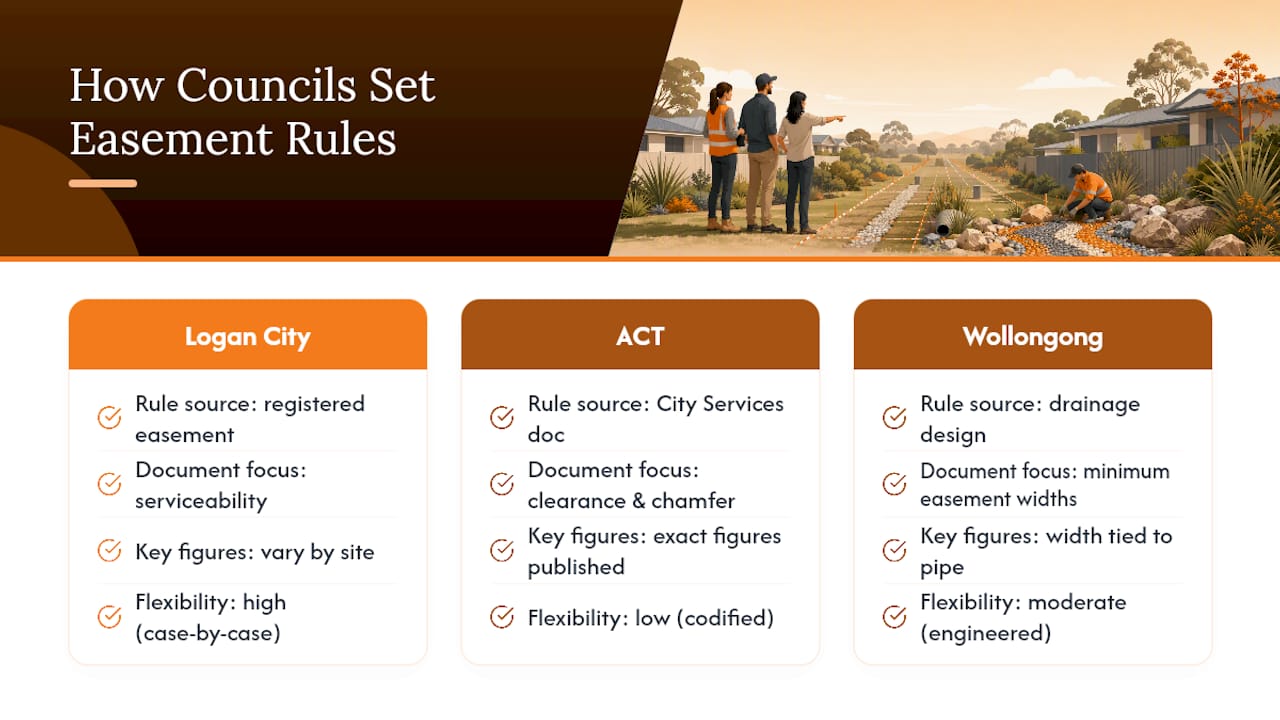
Yes, and the variation is bigger than most homeowners expect. Councils write their own stormwater and drainage codes, and while the underlying logic is consistent (protect access, protect capacity), the specific numbers differ from one local government area to the next.
Logan City Council’s guidance frames easement restrictions around long-term serviceability, explicitly telling residents to confirm their own easement document rather than assume a blanket rule applies, because allowances vary site by site. That single line matters more than it sounds: two houses on the same street can have different permitted uses if their easements were registered at different times or serve different pipe sizes.
The ACT takes a more codified approach, with City Services publishing exact clearance figures, turning chamfer dimensions, and vegetation height thresholds in a dedicated technical document rather than leaving it to case by case judgment. That gives ACT residents more certainty upfront but less flexibility to negotiate an exception.
Wollongong’s approach leans on minimum easement widths tied to the drainage design itself, meaning the acceptable footprint for landscaping is a function of the engineering behind the pipe, not a fixed number that applies citywide.
The practical takeaway: don’t rely on advice from a different council area, a real estate agent, or a neighbor’s experience. A rule that held up three suburbs over, or even next door if the easement was registered differently, may not apply to your title. Every jurisdiction example above points back to the same first move, which is reading your own easement document and calling your own council before assuming anything.
How Does Easement Landscaping Affect Drainage and Flood Risk?
The connection between what you plant and how your street floods is more direct than most people assume. A stormwater channel is sized by an engineer to carry a specific volume of water during a design storm event, and every square meter of intrusion into that channel chips away at the margin built into that calculation.
Rock or gravel piled without inlay is the clearest example. It doesn’t just look untidy from an engineering standpoint, it physically narrows the wetted area available for water to move through, which pushes the flow higher and faster and increases the odds of overtopping during a heavy downpour. Dense root systems do something similar underground: roots can infiltrate joints in older pipe materials, and root mass around a pipe can restrict the soil’s ability to let water percolate away from the surface, adding to surface runoff instead of absorbing it.
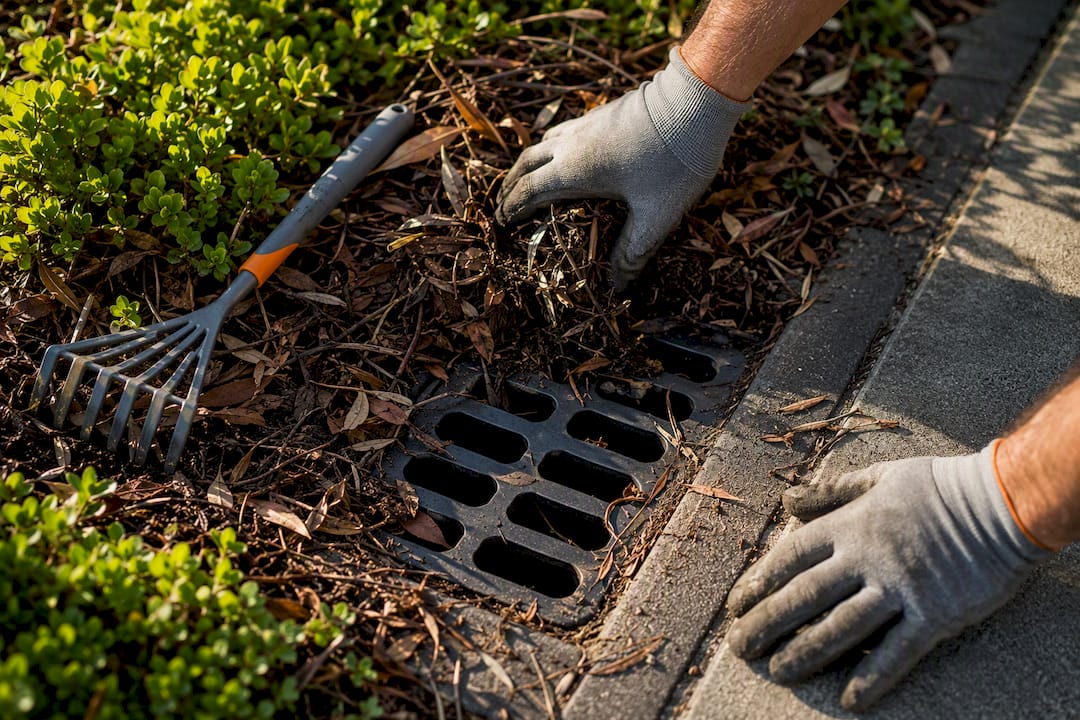
Overgrown vegetation creates a different problem. Leaf litter, fallen branches, and dense low growth can catch debris at the entry point to a pipe or grate, and a partially blocked inlet behaves the same as an undersized pipe during a storm, backing water up onto the surface faster than it should.
None of this means landscaping and drainage performance are opposites. Correctly inlaid rock, low groundcover with fibrous roots, and a clear access corridor add value to a yard without touching the channel’s carrying capacity. The problems only show up when landscaping treats the easement like ordinary garden space instead of active infrastructure, which is the mistake council rules are specifically written to prevent.
How Should You Manage Easement Vegetation Over Time?
Getting the initial planting right is only half the job. Easement vegetation needs a maintenance rhythm that most standard garden beds don’t, because the consequence of neglect isn’t just an untidy yard, it’s a call from council asking you to remove something at your own cost.
Groundcovers and low shrubs planted under 1.5 meters still grow, and species that looked compact at purchase can drift taller or wider than expected within a couple of seasons. Build a habit of checking height and spread against your original approval every year, not just when something looks obviously overgrown. If a plant starts approaching the height threshold, cut it back hard or replace it before it becomes a compliance issue rather than after.
Replacement strategy matters as much as initial selection. When a shrub dies, gets root bound, or simply outgrows its spot, resist the urge to grab whatever’s available at the nursery that day. Cross check the replacement against the same criteria you used originally: shallow roots, low mature height, non invasive spread. Keeping a simple record, even a phone photo log with dates, gives you something concrete to show council if a maintenance request ever gets questioned.
Seasonal debris is the other half of long-term management. Leaf litter and fallen branches around inlets or grates should get cleared on a regular schedule, not left until visible pooling forces the issue. A landscape maintenance plan that treats the easement strip as its own line item, separate from the rest of the yard, tends to catch problems before they become removal orders.
How Do You Resolve Easement Disputes With Neighbors or Council?
Easement disputes usually start small: a fence line that drifted, a shared driveway crossing the corridor, or a neighbor’s tree dropping roots into a shared pipe run. Left alone, they escalate fast because both parties assume they’re in the right.
Start with documentation, not confrontation. Pull the title and deposited plan for both properties if the dispute involves a shared boundary, and get the exact easement dimensions in writing before raising the issue with anyone. Half of neighbor disputes over easements dissolve once both sides see the actual registered width and realize the disagreement was based on a guess rather than the plan.
If the dispute is with council rather than a neighbor, typically over a removal notice or a rejected landscaping application, ask specifically which clause or technical requirement the decision is based on. Council officers work from published guidance, and knowing the exact rule (a clearance dimension, a prohibited species list, a maximum height threshold) gives you something concrete to either comply with or formally appeal.
Mediation services through your state’s local government ombudsman are worth using before a dispute reaches legal threats, especially for neighbor to neighbor issues where nobody’s landscaping was ever formally approved in the first place. And if council has granted permission that’s later revoked, remember that permission over an easement is typically conditional and revocable, which means the fastest resolution is usually compliance rather than a fight you’re unlikely to win.
Rokworx’s Take on Tight-Access Rock Work Near Easements
Easement work is where the gap between “technically allowed” and “actually buildable” shows up fastest. We’ve seen plans get council sign off on paper and then stall on site because nobody measured whether a machine could physically get in to do the inlay excavation without crossing a boundary it wasn’t supposed to touch.
Our approach starts with the same access math the council will check: corridor width, turning chamfer, and pipe depth, before we ever talk about rock selection or dry riverbed design. Combining correct inlay technique with a dry riverbed or low retaining edge is one of the more forgiving ways to add visual interest to an easement strip without touching drainage capacity, but only when the excavation depth is documented and matched to council specs. For anything with tight machinery access or a pipe shallower than about 2 meters, get a contractor to assess the site and put the method in writing before you start, not after an inspector asks for it.
— MYBMC
How Rokworx Handles Compliant Rockwork Near Easements
Getting easement landscaping right usually comes down to execution, not just knowing the rules. Experienced contractors can handle rock supply, correct inlay installation, retaining wall construction, and earthmoving, and every one of those services matters when the ground you’re working on doubles as council infrastructure.

Hiring an experienced contractor for this kind of work isn’t about convenience, it’s about protecting what’s buried under your yard and avoiding a removal order that costs you twice: once to build, once to tear out. Rokworx can assess your site, confirm access clearances, and document the excavation method a council may ask to see before signing off on a rock feature or retaining edge near your easement. If you’re weighing rock wall options for a boundary near a drainage corridor, browse rock wall ideas for what’s actually achievable within typical clearance rules, or request a site assessment to get a method that will hold up to inspection the first time.
Sources
- Stormwater drainage easements — Logan City Council
- Stormwater applications — City Services (ACT)
- Easements — City of Wollongong
FAQ
Can You Landscape Over an Easement?
Yes, in most cases. Turf, groundcovers, and low shrubs under about 1.5 meters are commonly permitted, but permanent structures and anything that blocks access or drainage capacity typically aren’t.
What Are Some Good Landscaping Ideas for an Easement?
Inlaid rock features, dry riverbeds, low native shrubs, and ornamental grasses with fibrous roots all work well because they add visual interest without raising the ground level or sending roots toward the pipe. A modern rock landscaping approach that keeps the surface grade level with the original ground is usually the safest bet for approval.
Can You Build on a Stormwater Easement?
Generally no. Buildings, sheds, pools, and permanent footings are excluded by most council policies, since they block access and can compromise the pipe or channel beneath the surface.
Do Downpipes Have to Be Connected to Stormwater?
Requirements vary by jurisdiction and property type, so check your specific council’s building and stormwater connection rules rather than assuming a blanket answer, since some areas mandate direct connection while others allow alternatives like rainwater tanks under certain conditions.
Who Do I Contact to Get Permission for Easement Landscaping?
Contact your local council’s engineering or stormwater services department directly and request written permission or a licence agreement before starting any work, since verbal approval typically isn’t binding.


10 Comments
jitu100linkalternatif
Finding a working link can be a pain but this alternative site is a lifesaver. Stable connection and no lag during the big wins. Go to jitu100linkalternatif
617betapp
The app version is just fantastic. It makes betting on the go so much easier and the updates are frequent. Download 617betapp and start winning.
imperiumvans
Own the Road. Command the Water
reliefmedspharma
Order Pure Molecule relief Meds Canada ✅
gunnersmart
Buy Sophisticated Hand Guns Now
champion-bulldoggen
Champion-Europäische Bulldoggenwelpen zur Adoption
puremoleculelabs
https://puremoleculelabs.com Molecular Labs
ketamight
https://ketamight.com – Order Ketamine
taktikwacht
Kaufen Sie diskret die besten Handfeuerwaffen in Europa
casinorushbetcasino
What a rush of excitement when I first signed up. I love how the interface stays clean while packing a massive library of slots and live tables. The welcome bonus matched my deposit perfectly and I actually got to test it out without any hidden traps. Keep up the fantastic work and I will be playing here for seasons to come. casinorushbetcasino