

A swale is a shallow trench that slows water down and lets it soak into the ground. A berm is a raised mound that blocks or redirects water before it reaches something you want protected. If your yard has standing water spread across a wide area, dig a swale. If runoff is charging toward your foundation or a slope, build a berm. Many of the best drainage fixes use both together.
TL;DR:
- Swales should be sized with a bottom width of 4 to 8 feet and gentle slopes to prevent erosion and ensure proper infiltration.
- Proper compaction and spillway sizing are critical for berms to avoid them becoming drainage liabilities during heavy storms.
- Vegetation on swales should be drought-tolerant or wetland-friendly to handle seasonal fluctuations without maintenance issues.
- Combining a swale with a downstream berm effectively captures water and redirects runoff away from structures in stormwater management.
- Professional machine work and precise construction are recommended for complex sites, slopes, or large volume projects to prevent failure and ensure longevity.
Table of Contents
- Swale vs Berm: What Each One Actually Is
- How Swales and Berms Manage Water (and When to Use Each)
- Design Basics: Sizing, Slopes, Check Dams, and Spillways
- Building It Right: Construction Tips and Mistakes to Avoid
- Use Cases and a Quick Decision Checklist
- What Homeowners Underestimate About Berm and Swale Installation
- Get Professional Help Building Your Swale or Berm
- Sources
- FAQ
Swale vs Berm: What Each One Actually Is
A swale is negative space. It’s a dug channel, usually shaped like a shallow “U” or trapezoid, designed to catch runoff and either spread it out or let it sink into the soil. Depth typically runs up to about 16 inches, with widths reaching around 4 feet on residential sites, according to water-sensitive urban design guidance from Western Australia. You’ll also hear swales called bioswales or vegetated swales when they’re planted with grasses or sedges to filter runoff as it moves through.
A berm is positive space, the opposite move entirely. It’s a compacted earthen mound, often only a few inches to a few feet high, that physically stops water or forces it to change direction.
The contrast matters more than it sounds:
- A swale lowers the ground to invite water in and hold it long enough to infiltrate.
- A berm raises the ground to keep water out or push it somewhere else.
- Swales manage volume over time; berms manage direction and force in the moment.
How Swales and Berms Manage Water (and When to Use Each)
A swale slows water down, spreads it across a wider footprint, and gives it time to sink into the soil rather than run off. A berm does the opposite job: it blocks flow entirely or diverts it around whatever you’re trying to protect. Neither is universally “better.” They solve different problems.
Here’s how that plays out on an actual property:
- Rain gardens and planted beds. A swale channels overflow toward the planting area and lets it soak in slowly, which is why bioswales show up constantly in rain garden and green infrastructure designs.
- Orchards and sloped plantings. A swale on contour holds moisture near root zones longer, which matters most in dry climates where every drop of rain needs to count.
- Foundation protection. A berm intercepts sheet flow before it reaches a wall, redirecting it to a safer discharge point instead of letting it pool against masonry, as explained in the role of landscaping in waterproofing your property.
- Roadside or driveway drainage. A berm or curb-style mound keeps water off pavement and pushes it toward a swale or drain.
The combination pattern, an on-contour swale paired with a downhill berm, shows up constantly in permaculture and stormwater design because it captures water AND keeps it away from structures in one stroke.
Design Basics: Sizing, Slopes, Check Dams, and Spillways
Getting the dimensions right is the difference between a drainage feature that works for a decade and one that erodes after the first heavy storm.
For swales, Nashville’s stormwater management manual recommends trapezoidal channels with bottom widths of 4 to 8 feet for larger systems, though residential swales run narrower. Longitudinal slope matters just as much as width.
Slope limits that actually get followed by engineers: Level 1 swales are recommended to have a relatively gentle longitudinal slope to control flow; steeper slopes risk erosion rather than proper drainage.
Key rules of thumb to check before you dig or mound anything:
- Keep swale bottoms flat and level, not sloped side to side, so water spreads instead of channeling.
- Space check dams to prevent ponding depths from exceeding a few inches at peak flow. Check dams turn one long sloping swale into a series of shallow holding cells, which cuts erosive velocity dramatically.
- Compact berm soil in layers rather than dumping and walking away. Loose fill settles unevenly and cracks.
- Size any spillway to pass your worst-case storm overflow without eroding the berm’s downhill face.
- If your soil is heavy clay with poor drainage, expect to need underdrains or engineered media rather than a plain dirt swale.
Skipping soil permeability testing is the single most common design failure. A swale dug into compacted clay won’t infiltrate anything; it’ll just sit there as a mosquito pond.
Building It Right: Construction Tips and Mistakes to Avoid
The most efficient build method is cut-and-fill: dig the swale first, then use that exact soil to build the adjacent berm. No importing fill, no wasted material, and the grading naturally follows your site’s contours. Landscapers commonly use this approach specifically because it saves both money and truck trips.
Compaction is where most DIY berms fail. Loose soil erodes fast and settles unevenly, so tamp each layer as you build rather than piling it all at once. Mulch or plant the berm’s surface within days of finishing it, before the first real rain tests your work.
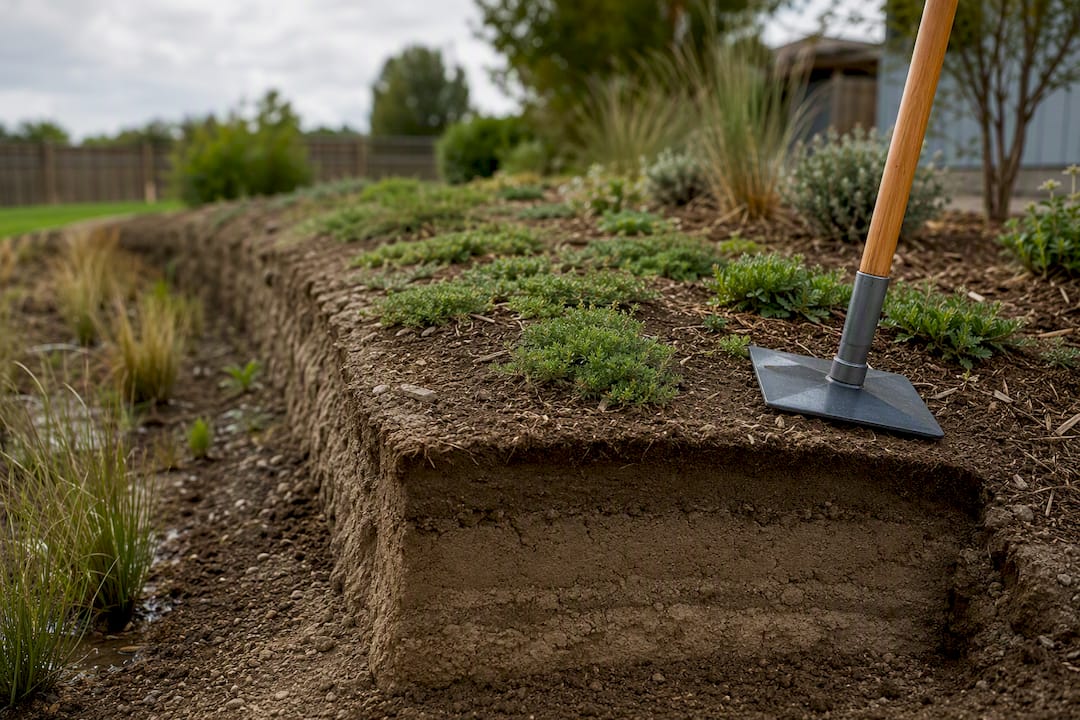
Vegetation choice depends on the zone. Swale bottoms need species tolerant of both saturated soil and dry spells, since they’ll swing between flooded and bone dry depending on the season. Native sedges and drought-tolerant groundcovers handle that swing better than typical turf grass.
Pro Tip: Plant your swale bottom and berm crest with different species. The bottom needs wet-dry tolerance; the crest just needs to hold soil against wind and foot traffic.
Maintenance checklist for both features:
- Desilt the swale after major storms so sediment doesn’t choke infiltration.
- Clear check dams and spillways of debris before the wet season starts.
- Inspect berm surfaces each spring and fall for cracking or slumping.
- Reseed bare patches immediately. Bare soil is where erosion starts.
Use Cases and a Quick Decision Checklist
A flat yard with water pooling everywhere after rain almost always calls for a swale. It’s spreading rainfall’s job, not blocking it.
A yard where runoff funnels downhill toward a house, shed, or patio needs a berm, or a berm-and-swale combination if you also want to capture some of that water instead of just diverting it.
Run through this before you commit to either:
- Infiltration test. Dig a hole, fill it with water, and time how fast it drains. Slow drainage means a swale alone won’t cut it.
- Available width. Swales need horizontal space; if you’re working with a narrow side yard, a berm might fit better.
- Distance to structures. Water diverted by a berm has to go somewhere. Know your discharge point before you build.
- Slope percentage. Anything over roughly 5% grade complicates both features and may need terracing.
- Soil type. Sandy soil favors swales; dense clay favors berms or engineered drainage.
What Homeowners Underestimate About Berm and Swale Installation
Most people treat swale and berm work as a weekend shovel project, and for small, flat, sandy-soil sites, it often can be. The trouble starts when the site has any complexity at all: a slope near a foundation, heavy clay that won’t infiltrate, or a runoff volume big enough that hand tools can’t move the dirt fast enough before the next storm arrives.
Compaction is the detail DIYers skip most often, and it’s the reason so many backyard berms slump or wash out within a year. Professional guidance is consistent on this point: without proper compaction and spillway sizing, a berm becomes a drainage liability rather than a fix. On tight-access sites or steep grades, machine compaction and precise rock placement do a job hand tools simply can’t match. If you’re mapping out a larger project, Rokworx’s drainage swale design guidance covers the local considerations that trip up first-time builders.
— MYBMC
Get Professional Help Building Your Swale or Berm
Rokworx is the practical alternative to guessing your way through a shovel-and-wheelbarrow drainage project. When the job involves moving real volume, cutting into a slope near your house, or grading a spillway that actually needs to survive a storm, machine work and experienced placement beat DIY trial and error every time.

Rokworx handles the parts of swale and berm construction that punish mistakes the hardest: excavator hire for cutting and shaping channels, earthmoving and excavation for larger cut-and-fill jobs, and rock supply for stabilizing spillways and berm faces where plain soil won’t hold. If your project involves a retaining structure near the berm, or you’re stabilizing a slope with rock walls or gabion walls, that’s core Rokworx territory too.
Ask for a quote once you’re dealing with large-volume cut-and-fill, a slope close to a foundation, or spillway work that needs to be engineered rather than eyeballed. Visit Rokworx’s landscaping rock supply and installation page to see the full range of services and request a site estimate.
Sources
- Water-sensitive urban design: swales and buffer strips (Western Australia)
- Stormwater management manual — water quality swales (Nashville)
- Green infrastructure benefits of vegetated swales (Minnesota Stormwater Manual)
- Planning and design of vegetated buffers (Queensland wetlandinfo)
FAQ
What Is the Difference Between a Berm and a Swale?
A swale is a dug trench that slows and infiltrates water; a berm is a raised mound that blocks or diverts it. One lowers the ground, the other raises it.
What Is the Main Purpose of a Swale?
A swale’s main job is to slow runoff, spread it out, and give it time to soak into the soil instead of running off the surface, which reduces erosion and recharges groundwater near plant roots.
What Is Another Name for a Swale?
Swales are also called bioswales or vegetated swales, especially when planted with grasses or sedges that filter runoff as it passes through.
What Is the Difference Between a Berm and a Dyke?
A berm is typically a smaller, informal mound used for landscape-scale water diversion, while a dyke (or levee) is a larger, often engineered flood-control structure built to hold back significant water volumes, such as a river or tide. If you’re dealing with anything closer to flood-control scale, retaining wall drainage guidance explains where a backyard berm ends and structural engineering begins.
Will a Swale Attract Mosquitoes?
Not if it’s designed correctly. Swales that drain or infiltrate within 24 to 48 hours don’t hold water long enough for mosquitoes to breed.


11 Comments
brafunvip
The bonuses here are legit and not just bait. I had a great experience with the registration process. Give brafunvip a shot if you are looking for some real action.
Cinda
What’s uup tto all, hhow iis everything, I think evry
onne is getting mre ffrom this website, aand yoour viewss aree nice forr nnew users.
xnxx
Heree iss myy blog: bokep
win222downloadapk
Finally found a reliable source to get the APK. Installation was quick and it works without any glitches. Download via win222downloadapk!
pk68vippk
Finally found a platform that doesn’t lag during peak hours. The game variety is impressive and the customer support is actually helpful. pk68vippk is definitely my new go-to.
schaeferhundblutlinien
Reinrassige Deutsche Schäferhundwelpen europaweit verfügbar 🐕🦺
ragsiamglanz
Ragdoll-, Siam- & Ragamese-Kätzchen europaweit🐱
papageienparadies
Europas Premium-Papageien aus Hausaufzucht 🦜
imperiumvans
Own the Road. Command the Water
phkavbet
Solid platform with a lot of exciting options. I really appreciate the transparency in their terms. Give phkavbet a go
pk888gj
Really loving the game variety here. I had a great run last night and the bonuses are actually worth it. Check out pk888gj if you want a fun experience.
jljl33applogin
I finally found a working link for the app. The login process is super smooth and the games load quickly. Definitely worth a try for anyone looking for a stable platform. Check out jljl33applogin